How to size a power station for a construction site
“`html
Surge multiplier for power tools
Planning usable capacity
Minimum for light-duty setups
Contents
Getting the wrong size portable power station for your construction site means either underpowered tools that won’t start, or overspending on capacity you’ll never use. This guide walks you through the exact calculations contractors use to size power stations correctly—no guesswork, no oversized units eating your budget.
Power Station for Construction Sites: Power Needs Assessment
Start by listing every piece of equipment you’ll run simultaneously. Don’t estimate—check the nameplate on each tool for actual wattage. Most contractors make the mistake of adding up everything they own instead of what runs at once.
For construction sites, your power load typically breaks into three categories:
Continuous Power Tools: Lights, chargers, small grinders, drills. These run steady at their rated wattage.
Motor-Driven Equipment: Circular saws, compressors, pumps. These need 3-5x their running watts to start up.
Specialty Equipment: Welders, plasma cutters, large mixers. High draw, specific voltage requirements.
Use tool nameplate ratings as a conservative starting point, but do not assume they reflect normal running draw. A 15-amp circular saw (1800W label) may run closer to 1200-1400W under load. Use measured values when possible, and default to the rated input when you cannot verify real-world draw.
For larger motor-driven equipment, check whether the manufacturer lists power factor or VA requirements. Some construction equipment draws more apparent power than the simple wattage number suggests, especially compressors, pumps, and specialty tools. Single-phase tools are usually easier to size than three-phase equipment.
Surge vs Continuous Watts
This is where most sizing goes wrong. Your portable power station needs two different capacities:
Continuous Output: What it can deliver steadily without overheating. Use the manufacturer’s continuous output rating, then add your own 20% buffer instead of running the unit at its limit all day.
Surge Capacity: Short-term power burst for motor startup. Typically 2x continuous for 30 seconds, but varies by manufacturer.
| Tool Type | Running Watts | Surge Multiplier | Startup Watts |
|---|---|---|---|
| Circular Saw (7.25″) | 1,400W | 3x | 4,200W |
| Air Compressor (3HP) | 2,200W | 5x | 11,000W |
| Angle Grinder (9″) | 2,400W | 2x | 4,800W |
| Miter Saw (12″) | 1,800W | 3x | 5,400W |
Here’s the critical part: surge capacity must handle your largest single tool’s startup. If you’re running a 1,400W saw that needs 4,200W to start, your power station’s surge rating must exceed 4,200W—even if your total continuous load is only 800W.
Portable power stations and diesel generators handle surge differently. Many 3,000W portable power stations advertise short surge windows, while jobsite generators may tolerate motor startup loads differently depending on alternator design and engine capacity. Always compare the surge rating, surge duration, and tool startup requirements before choosing.
Battery Capacity Calculations
Battery capacity determines runtime, measured in watt-hours (Wh). The math is straightforward:
Runtime Hours = Battery Capacity (Wh) ÷ Load (W) × 0.8
The 0.8 factor is a conservative planning allowance for inverter losses, cold-weather performance, battery aging, and reserve capacity. Modern LiFePO4 power stations include battery management systems, but planning around 80% usable capacity helps avoid running the unit to empty on a jobsite.
A 2,000Wh battery running 800W of continuous load should be planned around roughly 2 hours of reliable jobsite runtime after accounting for inverter losses, temperature effects, battery age, and reserve margin.
Calculate your daily energy needs by adding up each tool’s power draw multiplied by hours of use:
- LED work lights (100W × 8 hours) = 800Wh
- Tool chargers (200W × 4 hours) = 800Wh
- Grinder (1,200W × 2 hours) = 2,400Wh
- Daily Total: 4,000Wh
For this example, you’d need a 5,000Wh minimum battery capacity to run a full day with safety margin.
If you want to run the numbers faster, use the VoltWorkHQ battery sizing estimator to calculate daily load, autonomy, efficiency loss, and recommended battery bank size based on your actual equipment.
LiFePO4 batteries are generally the better fit for construction use because they handle frequent cycling well, offer strong thermal stability, and usually provide longer cycle life than older lead-acid designs. If comparing other lithium-ion chemistries, check the manufacturer’s temperature limits, safety certifications, enclosure durability, and warranty terms before using them on a jobsite.
For jobsite electrical safety, also follow applicable guidance from OSHA electrical safety standards when using portable power systems around tools, cords, chargers, and temporary work areas.
Runtime Requirements
Runtime planning varies by site type and access to recharge options. Remote locations need different calculations than suburban builds with grid backup.
Half-Day Sites (4-6 hours): Minimum 1,500Wh for basic tool operation. Good for residential work with vehicle charging between sites.
Full-Day Sites (8-10 hours): 3,000-4,000Wh depending on load. Most commercial construction falls here.
Multi-Day Remote (24+ hours): 6,000Wh+ with solar recharge capability. Essential for off-grid locations.
Factor in weather delays that extend job duration. A rained-out crew still needs lights, chargers, and communication equipment. Size for your worst-case scenario, not typical days.
Peak demand usually hits mid-morning when all crews arrive and fire up equipment simultaneously. Size inverter output and surge capacity for this rush period. Size battery capacity for total watt-hours needed across the workday.
Recharge Methods and Planning
Your recharge strategy determines actual usable capacity. A 3,000Wh battery that takes 12 hours to recharge from AC won’t support continuous operation.
AC Charging (Fastest): 1,500-2,000W input typical. Full recharge in 2-4 hours depending on battery size. Requires grid access or generator.
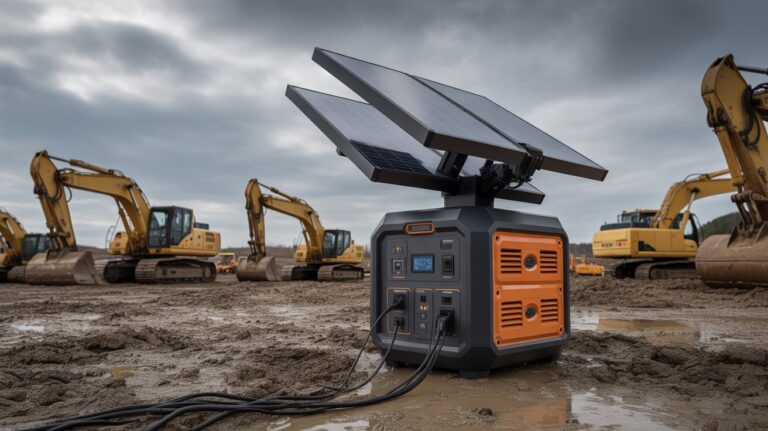
Solar Panels (Variable): 400-800W arrays common for portable stations. Expect 4-6 hours peak sun for full recharge. Weather dependent.
Vehicle Charging (Slow): 100-200W from 12V outlet. Emergency backup only—takes 15+ hours for meaningful charge.
For construction sites, hybrid charging works best. Use AC when available, solar during breaks, and vehicle charging as backup. As a rough shortcut, a solar array around 20-25% of battery capacity may support same-day recharge under good conditions, but the more reliable estimate is: solar watt-hours per day = panel watts × peak sun hours × 0.7-0.8.
| Recharge Method | Input Power | 2,000Wh Recharge Time | Best Use Case |
|---|---|---|---|
| AC Wall Outlet | 1,500W | 2.5 hours | Overnight, lunch breaks |
| Solar (400W) | 300W avg | 6-8 hours | All-day outdoor sites |
| Vehicle 12V | 120W | 18+ hours | Emergency only |
| Generator AC | 1,500W | 2.5 hours | Remote sites with fuel |
Construction Site Sizing Worksheet
Use this step-by-step process to size any construction site power station:
Step 1: List Simultaneous Equipment
- Tool 1: _____ watts running, _____ watts surge
- Tool 2: _____ watts running, _____ watts surge
- Tool 3: _____ watts running, _____ watts surge
- Total Continuous Watts: _____
- Highest Single Surge: _____
Step 2: Add Safety Margins
- Continuous capacity needed: Total watts × 1.2 = _____
- Surge capacity needed: Highest surge × 1.1 = _____
Step 3: Calculate Battery Size
- Hours of operation needed: _____
- Energy required: Continuous watts × Hours × 1.25 = _____ Wh
- Battery capacity needed: _____ Wh
Step 4: Verify Recharge Capability
- Recharge time available: _____ hours
- Required recharge rate: Battery size ÷ Recharge hours = _____ watts
- Available input power: _____ watts
If recharge rate exceeds available input power, increase battery capacity or reduce runtime requirements.
Key Sizing Takeaways
- Calculate surge requirements separately—motor startup kills undersized units
- Size continuous output for simultaneous tools plus 20% safety margin
- Battery capacity should support a full workday while planning around 80% usable capacity
- Match recharge capability to daily energy consumption
- LiFePO4 chemistry offers best construction site performance
- Always plan for worst-case scenarios, not average conditions
Frequently Asked Questions
What size power station do I need for basic construction tools?
Most light-duty construction setups need 1,500-2,000W continuous capacity with 4,000-6,000W surge capability. This can support basic tools like drills, lights, chargers, and some saw use, but larger grinders, compressors, miter saws, or multiple crews may require 2,000-3,000W+ continuous output and higher surge capacity.
Can a portable power station replace diesel generators on construction sites?
Portable power stations work well for smaller tools and equipment but struggle with high-draw items like large compressors or welders that diesel generators handle easily. They excel in noise-sensitive areas and provide cleaner power for electronics.
How do I calculate runtime for my specific tools?
Add up the wattage of all tools running simultaneously, then divide battery capacity by total watts. Multiply by 0.8 for realistic runtime accounting for efficiency losses and planning reserve.
What’s the difference between surge watts and continuous watts?
Continuous watts is what the power station can deliver steadily without overheating. Surge watts is the short-term burst capacity for starting motors—typically 2-3x continuous for 10-30 seconds depending on the unit.
Should I size for peak demand or average usage?
Size inverter output for peak simultaneous running load and the largest likely startup surge, not just average usage. Battery capacity should be sized separately based on total watt-hours needed across the workday.
Ready to Size Your Construction Site Power?
Use the worksheet above to calculate your exact requirements, then check our comprehensive guide to the best solar generators for construction sites to find units that match your sizing calculations.
“`