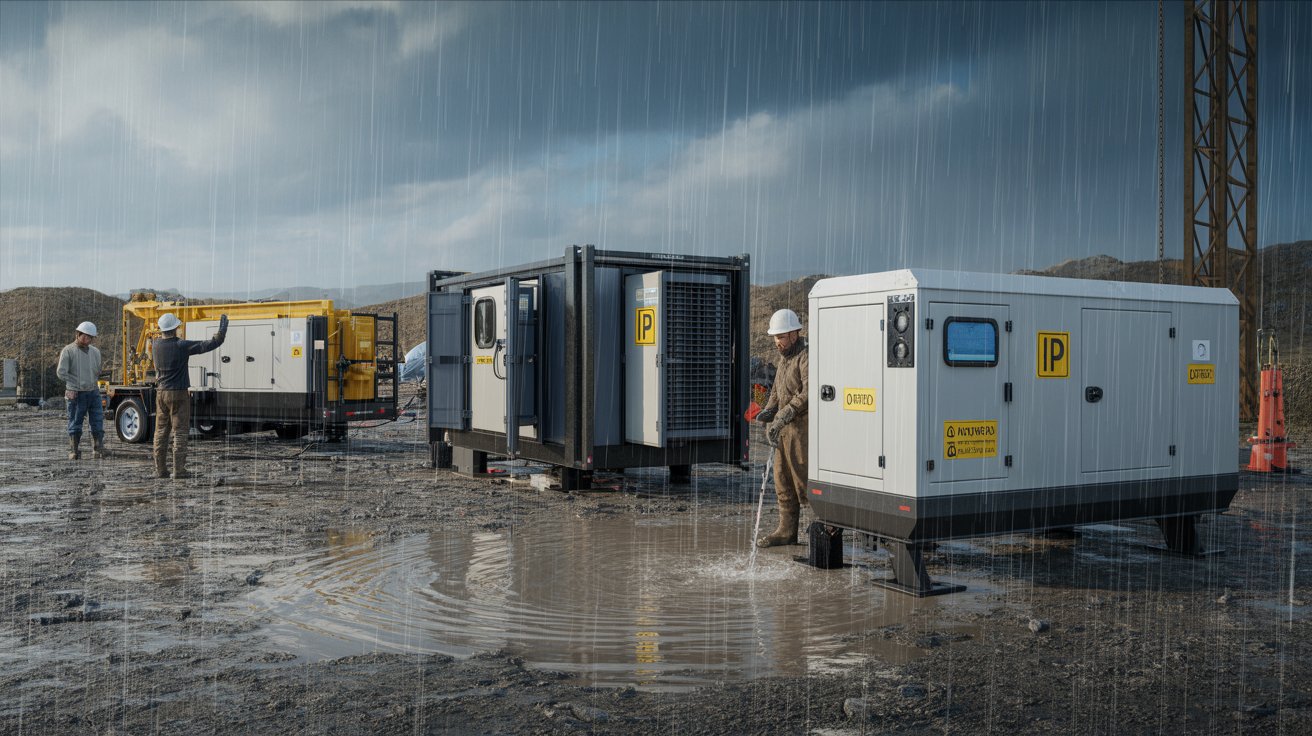
What Is an IP Rating? The Industrial Standard for Outdoor Power Stations
IP ratings tell you exactly how well your power equipment survives dust, rain, and jobsite conditions—critical intel for choosing outdoor generators and power stations that won’t fail when you need them most.
Common High Immersion Rating
Digits Define Protection
International Standard
Quick Navigation
You’re spec’ing power equipment for an outdoor job. The supplier throws around terms like “IP65” and “water-resistant,” but what does an IP rating actually tell you about whether your generator will survive a downpour or dusty conditions? Understanding IP ratings isn’t just technical trivia—it’s the difference between equipment that works when you need it and costly failures that shut down your operation.
What IP Rating Actually Means
IP stands for “Ingress Protection,” and it’s defined by the international standard IEC 60529. Every IP rating uses a two-digit system that tells you exactly what environmental conditions your equipment can handle.
The first digit rates protection against solid objects and dust. The second digit rates protection against water ingress. When you see “IPX4,” the “X” means that aspect wasn’t tested or doesn’t apply to that rating.
This isn’t marketing fluff—these are standardized test conditions. An IP65-rated power station has been tested in a lab under specific dust exposure and water jet conditions defined by IEC 60529. The manufacturer can’t just slap that rating on without documentation.
For power stations, always check whether the rating applies only when outlet covers, USB covers, AC charging inputs, and solar input caps are closed. Many IP ratings describe the sealed enclosure, not safe operation with open ports, exposed connectors, wet extension cords, or active charging in rain.
Higher numbers don’t always mean better for your application. IP54 might be perfect for covered outdoor work, while IP67 is overkill and adds unnecessary cost for the same job.
Breaking Down the Numbers
The first digit runs from 0 to 6 and covers solid object protection:
- 0: No protection
- 1: Protected against objects larger than 50mm (like hands)
- 2: Protected against objects larger than 12.5mm (like fingers)
- 3: Protected against objects larger than 2.5mm (like tools and thick wires)
- 4: Protected against objects larger than 1mm (like most wires and small tools)
- 5: Dust-protected (limited ingress that won’t interfere with operation)
- 6: Dust-tight (complete protection against dust ingress)
The second digit runs from 0 to 9 and covers water protection:
- 0: No protection
- 1: Protected against vertically falling water drops
- 2: Protected against water drops at 15° angles
- 3: Protected against spraying water up to 60° from vertical
- 4: Protected against splashing water from any direction
- 5: Protected against low-pressure water jets
- 6: Protected against powerful water jets
- 7: Protected against temporary immersion
- 8: Protected against continuous immersion under manufacturer-specified conditions
- 9: Protected against high-temperature, high-pressure water jets
IP Ratings Reference Chart
| IP Rating | Dust Protection | Water Protection | Typical Applications |
|---|---|---|---|
| IPX4 | Not rated | Splash resistance / light water exposure | Covered outdoor areas, light rain protection |
| IP54 | Dust-protected | Splash-resistant | General outdoor use, construction sites with overhead cover |
| IP65 | Dust-tight | Protected against low-pressure water jets | Exposed outdoor work, washdown areas, marine environments |
| IP66 | Dust-tight | Protected against powerful water jets | Heavy-duty marine use, pressure washing areas |
| IP67 | Dust-tight | Protected against temporary immersion, commonly 1 meter for 30 minutes | Flood-prone areas, temporary submersion risk |
| IP68 | Dust-tight | Protected against deeper or longer immersion, depending on manufacturer test conditions | Continuous submersion applications, underwater equipment |
Real-World Jobsite Applications
Your jobsite conditions determine what IP rating you actually need. Here’s how different work environments map to protection requirements:
Construction Sites with Overhead Cover: IP54 handles typical dust and occasional splash exposure. You’re not dealing with direct rain or pressure washing, so higher ratings add cost without benefit.
Exposed Outdoor Operations: IP65 becomes your baseline. Direct rain, blowing dust, and cleanup operations require dust-tight construction and water jet protection. This covers most agricultural applications and outdoor events.
Marine and Coastal Work: IP66 or IP67 depending on submersion risk. Salt air, heavy spray, and potential flooding demand maximum protection. The power equipment needs to survive not just water, but corrosive salt exposure. IP ratings do not certify corrosion resistance, so check coatings, connector materials, salt-spray testing, and maintenance requirements separately.
Emergency and Disaster Response: IP67 minimum. You’re dealing with unpredictable water exposure, potential flooding, and contaminated environments where equipment failure isn’t an option.
Don’t confuse IP ratings with impact resistance. An IP68-rated unit can still break if you drop it off a truck. Environmental sealing and physical durability are separate specifications.
Common IP Rating Mistakes
Assuming “Waterproof” Means Submersible: Marketing terms like “waterproof” don’t define actual capabilities. IP65 protects against water jets but fails under immersion. Only IP67 and IP68 handle submersion, and IP68 conditions vary by manufacturer.
Ignoring Temperature Limits: IP ratings apply under standard test temperatures. Your IP65 power station might maintain sealing at 25°C but fail at 50°C jobsite conditions. Check temperature specifications separately.
Mixing Up Temporary vs. Continuous Exposure: IP67 handles temporary immersion—typically 30 minutes at 1 meter depth. It’s not designed for continuous underwater operation. That requires IP68 with specific manufacturer depth and duration ratings.
Overlooking Maintenance Requirements: Seals degrade over time. Rubber gaskets compress, threads wear, and connections loosen. An IP65 rating applies to new equipment with properly maintained seals, not units that have been bouncing around job sites for two years.
When evaluating power stations and generators for outdoor work, the right solar generator combines appropriate IP rating with the power output and battery capacity your specific jobsite demands.
Selecting the Right Rating for Your Work
Match your IP rating to your worst-case environmental conditions, not typical conditions. Equipment fails when conditions exceed design limits, not during normal operation.
Indoor/Covered Outdoor: IP54 provides adequate protection for most construction and agricultural applications where equipment stays under cover or in enclosed trailers.
Direct Weather Exposure: IP65 handles rain, dust storms, and cleanup operations. This covers most outdoor generator and power station applications where equipment operates in open conditions.
Flood Risk or Marine Environments: IP67 for temporary submersion risk, IP68 for continuous exposure to water. Consider both depth and duration specifications from the manufacturer.
For active use, protect the connection points. An IP-rated enclosure does not make wet extension cords, open AC outlets, or exposed charging inputs safe. Keep cords, plugs, and charging ports dry, elevated, and protected according to the manufacturer’s operating instructions.
Cost increases with IP rating, but equipment replacement costs more than higher initial protection. Calculate replacement cost, downtime expense, and safety risks when choosing between rating levels.
Key Takeaways
- IP ratings follow IEC 60529 standard with two digits: first for solid object protection, second for water protection
- IP65 provides dust-tight and water jet protection suitable for most exposed outdoor applications
- IP67 handles temporary immersion (typically 1 meter for 30 minutes), while IP68 requires manufacturer-specific depth and duration specifications
- Higher ratings aren’t always better—match protection level to actual jobsite environmental conditions
- Maintenance affects sealing performance over time; IP ratings apply to equipment with properly maintained seals
- Temperature limits apply separately from IP ratings and affect sealing performance in extreme conditions
Frequently Asked Questions
Is IP65 better than IP67 for outdoor power equipment?
Not necessarily. IP67 handles temporary submersion, but it does not automatically include the same water-jet protection as IP65 or IP66. Choose based on your specific environmental hazards—flooding risk versus hose spray or washdown exposure. If both matter, look for a dual rating such as IP66/IP67.
Can I use an IP54-rated generator in the rain?
IP54 provides splash resistance but not protection against direct rain or water jets. Use it only under cover or in light, indirect moisture conditions. Direct rain exposure requires a rating designed for exposed weather, and all outlets, cords, and ports still need to be protected according to the manufacturer’s instructions.
What does IPX4 mean on power station specifications?
The “X” indicates the solid object protection wasn’t tested or rated. IPX4 means splash protection from any direction but no specified dust protection. This rating suits indoor use with occasional moisture exposure.
Do IP ratings guarantee equipment won’t fail in water?
IP ratings define specific test conditions, not unlimited water resistance. An IP67 unit survives 30 minutes at 1 meter depth under lab conditions but may fail with longer exposure, greater depth, damaged seals, open port covers, or exposed connectors.
How do temperature extremes affect IP ratings?
IP tests use standard temperatures, typically around 25°C. Extreme heat or cold affects seal materials and may compromise protection levels. Always check operating temperature ranges separately from IP ratings.
Need Help Selecting Power Equipment?
Understanding IP ratings is just one factor in choosing reliable outdoor power solutions. Use our jobsite power calculator to estimate load demand, check the battery sizing estimator for runtime planning, and browse our equipment guides for specific applications, power calculations, and real-world testing results to find the right setup for your jobsite conditions.