Off-Grid Power for Remote Field Operations: How to Size and Deploy a Portable Power Station for Professional Use
Remote field operations — from irrigation control to fence repair crews — need reliable power without fuel logistics, exhaust risk, or generator noise. This guide covers how to correctly size and deploy a portable power station setup for professional off-grid field use, including solar recharge strategies for multi-day deployment.
AC output available from current-gen field power stations
Common surge rating on 3,000W-class stations; verify motor startup load
LiFePO4 charge cycles to 70–80%+ remaining capacity (manufacturer-dependent).
- Why Contractors and Agricultural Crews Are Moving Away from Generators
- Sizing Your Field Power Load the Right Way
- Real Field Use Cases and What They Actually Draw
- Solar Recharge in the Field: Making Daily Consumption Work
- Deployment Considerations for Off-Grid Power in Remote Field Operations
- Field-Deployable Units: What to Evaluate at the 2,000Wh Class Entry Point
- Key Takeaways
- FAQ
Off-grid power for remote field operations isn’t a camping problem — it’s a logistics and load-management problem that directly affects your crew’s productivity and your operating costs. Whether you’re running irrigation pump control panels on a 500-acre property, maintaining livestock monitoring systems across a remote paddock, or supporting a fence repair crew three miles from the nearest outlet, the wrong power setup costs you time, fuel money, and sometimes compliance headaches you didn’t see coming. This guide is written for the people making those decisions: contractors, site managers, and agricultural operators who need reliable, deployable power without the overhead of running a gas generator every time someone needs to charge a tool or power a control panel.
Why Contractors and Agricultural Crews Are Moving Away from Generators
Gas and diesel generators have a real role in heavy construction — high continuous loads, long shifts, dedicated fuel supply on site. But in remote agricultural and field operations, they create problems that often outweigh the convenience.
Fuel logistics on a working farm or remote site are genuinely expensive. Running a 3,500W generator for eight hours burns roughly two to three gallons of fuel. Multiply that across a multi-day deployment or a seasonal irrigation setup, and you’re managing fuel transport, storage containers, and spill risk in terrain where none of that is easy. On a remote jobsite, that’s a supply chain problem. On a farm, it’s a recurring operating cost that adds up fast.
Exhaust and noise create real operational constraints. Enclosed equipment buildings, grain storage facilities, livestock barns, and poultry houses are environments where internal combustion engine exhaust is a direct hazard — to animals, stored product, and personnel. Electric fence controllers and livestock monitoring systems often need to run in or near those spaces. A generator simply isn’t appropriate in many of those locations. Beyond enclosed spaces, noise compliance is increasingly relevant for remote construction and infrastructure work in residential-adjacent areas.
Generator maintenance overhead is real on long-duration field deployments. Oil changes, air filter maintenance, starting failures in cold weather, and carburetor issues on equipment that sits between uses — all of these create downtime at moments when you need the power most. A LiFePO4 portable power station has no consumables, no fuel system, and no exhaust components to manage.
None of this means generators are always the wrong answer. But for a significant portion of agricultural and remote field work — especially loads under 3,000W running for controlled task windows — a properly sized portable power station with solar recharge is a cleaner, lower-maintenance solution.
Sizing Your Field Power Load the Right Way
Undersizing is the most common mistake in field power deployment. Most crews look at the nameplate wattage on their equipment and buy a station with roughly that capacity. That creates two problems: it ignores surge requirements, and it ignores runtime duration.
Step 1: Identify Every Load
List every device that will run from the station during a single shift. Don’t estimate — read the nameplate or spec sheet for each device. Split your list into two columns: continuous loads (things that run constantly) and intermittent loads (things that cycle on and off or run briefly). Common field loads include:
- Irrigation control panels and pump relays: typically 50–300W continuous
- Electric fence energizers: typically 5–25W continuous
- Livestock monitoring systems with cellular or satellite comms: typically 20–80W continuous
- LED work lighting arrays: typically 100–500W continuous
- Power tool chargers (circular saw, drill, impact driver): typically 80–300W each, intermittent
- Angle grinders and larger corded tools: typically 800–1,800W, intermittent
- Site office equipment (laptop, router, monitors): typically 100–300W continuous
Step 2: Calculate Continuous Load and Surge Requirements
Add your continuous loads together — that’s the baseline your station’s inverter must sustain without throttling. Then look at your highest-draw intermittent loads, particularly anything with a motor: pumps, compressors, and large power tools can draw 3x–7x their rated wattage at startup, depending on motor type, starting method, and nameplate LRA for a fraction of a second. Your station’s surge capacity must cover that peak, not just the continuous rated wattage.
For example: a 1,200W continuous pump motor may pull 3,600W–8,400W at startup depending on motor type and LRA rating. If your station’s surge rating is only 3,000W, it will fault on startup even though it can theoretically handle the continuous load. This is the calculation most buyers miss. A station with a 6,000W surge rating covers many common single-phase induction motors at 1,200W continuous — but does not universally cover worst-case LRA scenarios at the high end of the 7x multiplier. Always verify the motor nameplate LRA and the station’s surge-duration window — for pumps requiring surge above 6,000W, a higher-capacity unit or soft-start adapter may be required.
Your station’s surge capacity must be at least 3x–7x the wattage of your highest motor-driven load, depending on motor type, compressor load, starting method, and nameplate LRA/start amps. For field pumps and compressors drawing 1,200W–1,500W continuous, a 6,000W surge rating covers many common loads, but pump motors and compressors must be verified against nameplate LRA and the station’s surge-duration specification before assuming safe startup.
Step 3: Calculate Watt-Hours Needed Per Shift
Multiply each load’s wattage by the hours it will run during a shift, then add those figures together. That gives you the watt-hours (Wh) required per shift. As a starting framework:
- An irrigation control panel at 150W running an 8-hour shift = 1,200Wh
- Two livestock monitors at 40W each running 8 hours = 640Wh
- LED lighting at 300W running 4 hours = 1,200Wh
- Tool charging for a two-person crew over a shift = 400–600Wh
That example totals roughly 3,040–3,240Wh for a single shift. A single 2,000Wh station covers approximately 60–65% of that demand before needing recharge — which means solar supplementation during the shift, a second unit, or a staged approach where the station covers priority loads and non-critical loads are timed around recharge windows.
Use the battery runtime calculator to run your specific load combination and get a realistic runtime figure before you buy. For multi-load setups, the jobsite power calculator can help you work through the full picture.
Realistic Capacity Expectations
Current portable power stations in the 2,000–2,500Wh range — which covers the primary field-deployable units — are practical for task windows, priority loads, and partial-shift coverage. If your math is pushing 6,000Wh or beyond for a full shift, you are likely looking at either multiple units running independent circuits from separate stations, a single expandable unit with additional battery modules, or a solar-supplemented setup where daytime recharge offsets consumption and the station only needs to cover peak demand windows. Plan around that reality upfront rather than discovering it in the field.
Real Field Use Cases and What They Actually Draw
Irrigation Pump Control Panels
Pump controllers, relay panels, and solenoid valve systems typically run in the 50–300W continuous range — low draw, long duration. A 2,000Wh station can run a 150W irrigation controller for approximately 10–11 hours before hitting a 20% reserve threshold. That’s a full operating day on a single charge if the load stays isolated. Add in a modest solar input during daylight hours and you’re looking at sustained multi-day runtime when daily solar harvest consistently exceeds daily consumption and the battery retains sufficient overnight reserve — actual results depend on location, season, collector angle, and weather.
Livestock Monitoring and Electric Fence Controllers
Fence energizers and livestock monitoring systems are often among the lowest draws on a farm — 5–25W for most energizers, 20–80W for monitoring systems with comms hardware. The challenge is duration: these often need to run continuously, including overnight. A 2,000Wh station powers a 60W combined monitoring and fence system for roughly 22–24 hours after typical inverter losses while maintaining about a 20% reserve. That can cover most to all of a day-night cycle, with solar recharge needed during daylight hours to bring the station back up for the next cycle. This is exactly the kind of use case where a portable power station outperforms a generator — you’re not going to idle a gas unit overnight for a 60W load.
Portable Field Lighting
Early morning pre-dawn operations and post-sunset work are standard in agriculture and remote construction. A 300W LED lighting array running four hours consumes 1,200Wh — roughly 60% of a 2,000Wh station’s capacity for that one load. Size accordingly: if lighting is a primary load, plan for either a larger-capacity unit, a second station dedicated to lighting, or solar recharge between the morning and evening lighting windows.
Tool Charging for Fence Repair and Equipment Maintenance Crews
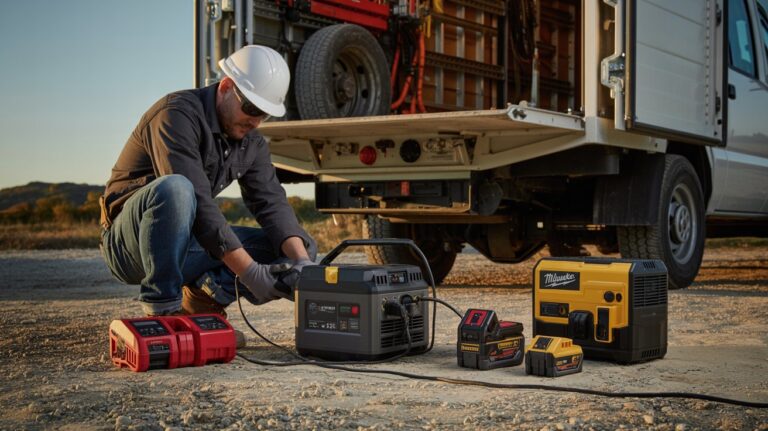
A two-person fence repair crew running cordless tools — drills, impact drivers, angle grinders — will burn through roughly 300–600Wh in tool charging over a full shift, depending on tool count and battery sizes. That’s a manageable secondary load on a 2,000Wh station, particularly if the primary load is low-draw monitoring equipment. The pure sine wave inverter output on current-generation stations matters here: tool battery chargers, particularly for professional-grade lithium-ion systems, are recommended for use with pure sine wave output — they perform better, run cooler, and have longer service life on pure sine wave versus modified sine wave unless the charger manufacturer explicitly states compatibility with modified sine wave. Verify inverter type before deploying. For more on why this matters for your tools, see the pure sine wave vs modified sine wave breakdown.
Remote Construction and Infrastructure Work
Noise compliance is a real constraint on infrastructure work near residential areas, in sensitive environments, or on sites with contractual noise limits. Some portable power stations advertise very low noise figures — EcoFlow rates the DELTA 3 Max Plus at ≤25dB at moderate load (600W) — but noise may increase at higher output levels. Verify the manufacturer’s dB rating and the load condition it was measured at before relying on it for compliance purposes. Generator noise is typically cited in the 65–75dB range, but these figures may be measured at different distances and under different load conditions than station noise ratings — confirm measurement distance and load conditions when using either figure for noise compliance documentation. That’s a meaningful operational advantage — not just a comfort factor but a compliance factor on relevant projects.
Temporary Site Offices and Communications
A laptop, a Wi-Fi router, and two monitors draw roughly 150–300W combined. Running that for a 10-hour site day uses 1,500–3,000Wh. A single 2,000Wh station covers a moderate site office setup for a full shift; heavier communication setups with satellite terminals, charging stations, and multiple workstations need either an expanded-capacity unit or staged recharge.
Solar Recharge in the Field: Making Daily Consumption Work
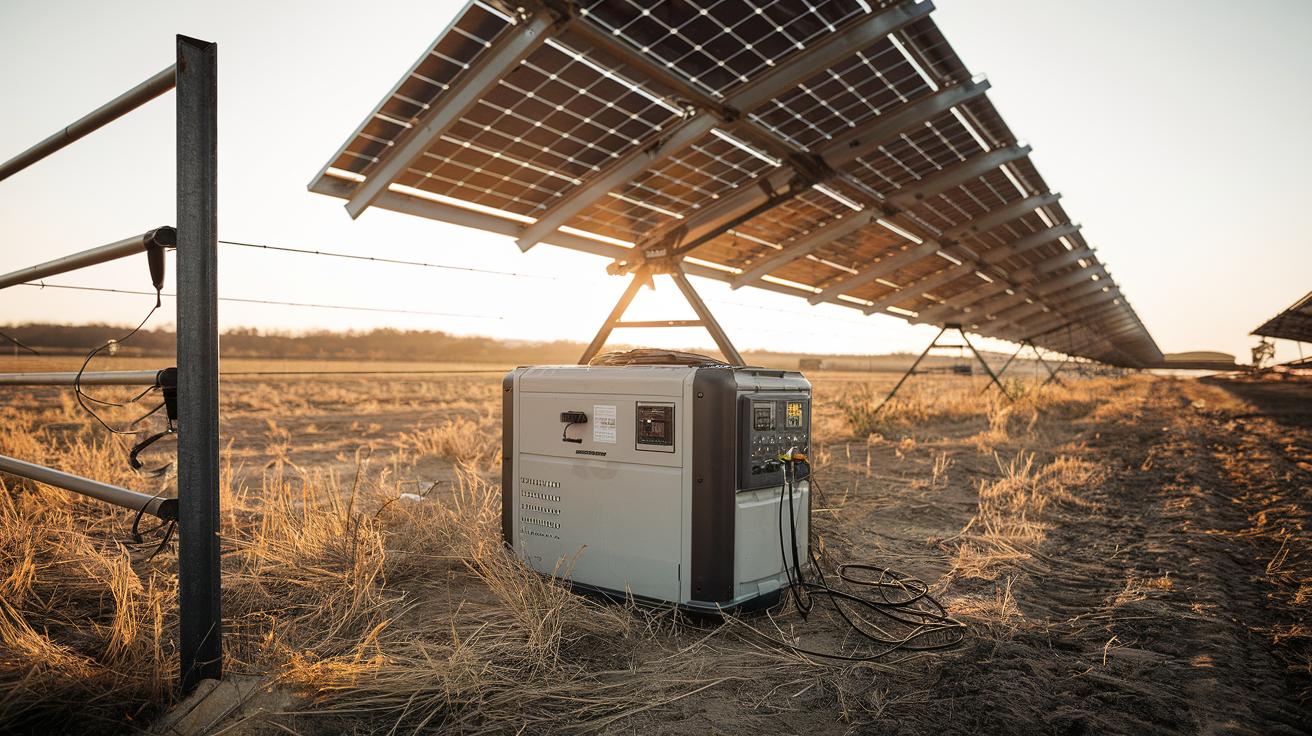
The real operational advantage of a portable power station in agriculture and remote field work is the ability to recharge from solar panels during the day while simultaneously running loads — potentially achieving net-zero daily consumption without any fuel input.
The math is straightforward: if your station is consuming 150W in continuous loads and your solar array is feeding in 400W, the station is net-gaining 250W per hour during peak sun. Over a six-hour solar window, that’s a theoretical 1,500Wh recovered — but accounting for typical MPPT and wiring losses of 10–15%, net recovery over six hours is more realistically 1,275–1,350Wh. That’s still sufficient to offset moderate continuous loads and restore capacity for overnight or early-morning peak demand windows, but size your array assuming real-world efficiency rather than the theoretical ceiling.
Key variables to understand before sizing a solar array for field recharge:
- MPPT controller efficiency: Current stations use MPPT (Maximum Power Point Tracking) charge controllers that maximize harvest from the connected panels. The rated solar input wattage on a station is the ceiling — real-world harvest varies with panel angle, temperature, and partial shading.
- Peak sun hours at your location: Agricultural and construction sites in the southern US average 5–6 peak sun hours daily; northern sites drop to 3.5–4.5. Size your array based on your realistic peak sun hours, not ideal conditions.
- Panel portability and setup time: Folding portable panels deploy in minutes; fixed-frame panels require mounting setup. For crews moving between locations, folding panels are the practical choice even if they’re slightly less efficient per square foot.
Use the solar panel calculator to determine how many panels you need to offset your specific daily consumption at your site’s peak sun hours. For a 2,000Wh daily consumption target in a 5-hour peak sun location, you need roughly 400W of panel capacity at minimum — more like 500–600W to account for real-world losses and partial cloudy periods.
For deployments of three or more days without grid access, solar recharge isn’t optional — it’s the operational backbone. Size your panel array to recover at least 100% of expected daily consumption during normal daylight conditions, with battery reserve for overnight loads and cloudy periods. For critical continuous loads, plan backup charging or extra battery capacity if solar harvest falls below the daily load.
Deployment Considerations for Off-Grid Power in Remote Field Operations
Temperature and Charging Constraints
LiFePO4 chemistry — which powers most current professional-grade portable stations — has a hard charging constraint at the lower end. Some units will not accept charge input below 32°F (0°C). This matters on early spring agricultural deployments, cold-climate construction, and overnight situations where temperatures drop below freezing. Check the manufacturer’s charge temperature specification before deploying in cold conditions. Discharging (running loads) typically tolerates a wider range than charging — but always verify both specs for your specific unit.
Outdoor Exposure and IP Ratings
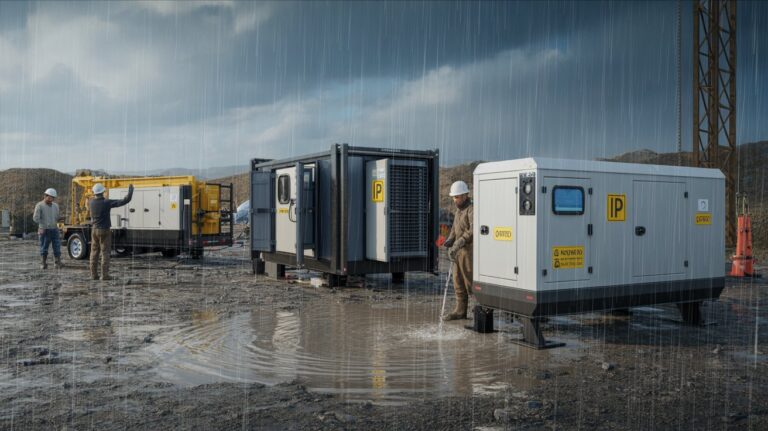
Most portable power stations are not designed for direct rain exposure or submersion. Before deploying a unit in an open field, on an exposed construction site, or in a location where it may be subject to dust, mud splash, or rain, verify the manufacturer’s IP rating for that specific unit. An IP rating is defined under IEC 60529: the first digit indicates solid particle protection, the second indicates liquid ingress protection. IP65 means dust-tight and resistant to low-pressure water jets — it does not mean submersible. Many portable stations carry no IP rating at all, meaning they should be deployed under cover or in an equipment enclosure in outdoor conditions. Do not assume a portable power station is weather-rated unless the manufacturer confirms it with a specific IP designation. For commercial field deployment, this matters for insurance and warranty purposes if the unit is damaged by weather exposure.
For commercial field deployments, verify the manufacturer’s safety listings and documentation alongside the IP rating. Using equipment outside its rated operating conditions can create warranty, compliance, and insurance review exposure if the unit fails or contributes to an incident on a commercial site.
Physical Security for Unattended Deployment
For deployments where the station will be left unattended overnight — along a remote fence line, in a paddock, or at a construction staging area — factor in physical security. Cable locks, locking equipment boxes, and integration with existing equipment enclosures are practical options. A 48–62 lb unit is portable enough to be stolen of opportunity; don’t leave high-value stations unsecured in exposed locations.
Weight and Transport
Units in the 2,000Wh class typically weigh between 48–62 lbs. That’s manageable for two-person deployment but not practical for a single operator to move repeatedly across a field. If your deployment involves frequent repositioning — moving with a crew from paddock to paddock, or relocating as a construction project advances — factor in whether you have a cart, UTV bed, or truck bed to move the station, rather than carrying it by hand.
Expandability for Growing Load Requirements
Several current units support expansion batteries that significantly increase total capacity. This matters for operations where load requirements may scale — adding a second irrigation zone, expanding a monitoring network, or supporting a larger field crew. Buying a base unit that can expand avoids having to replace the entire system when requirements grow. Verify the expansion battery compatibility and maximum system capacity before purchasing if scalability is a factor in your deployment.
Field-Deployable Units: What to Evaluate at the 2,000Wh Class Entry Point
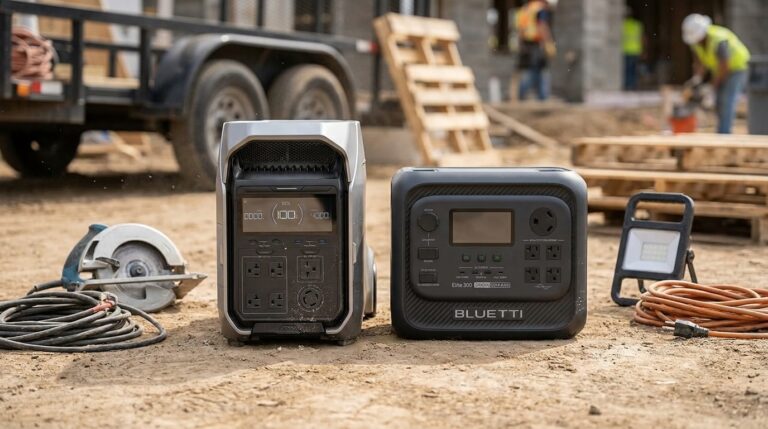
At the time of writing, two units stand out as practical options for professional remote field use at the 2,000Wh class entry point.
The EcoFlow DELTA 3 Max Plus starts at 2,048Wh and can expand to 10kWh with additional battery modules — a meaningful ceiling for multi-load agricultural deployments. It puts out 3,000W AC continuous with a 6,000W surge, which covers many field tools and some pump startup requirements described in this guide, but motor-driven loads still need to be verified against nameplate LRA and the station’s surge-duration limits. Solar input is rated at 1,000W MPPT, and EcoFlow rates AC recharge from 0 to 80% in approximately 43 minutes under rated conditions using X-Stream fast charging — verify the current spec sheet for required AC input level (circuit amperage) needed to achieve this rate, as vehicle/car charging through the DC input is a separate, slower option and will not replicate this recharge speed. At 48.7 lbs, it’s on the lighter end of the 2,000Wh class. EcoFlow rates noise at ≤25dB at 600W load — effectively very quiet at moderate output. Verify noise levels at your expected operating load, as fan activity and noise may increase at higher draw. EcoFlow backs it with a five-year warranty, which is above standard for this class. The inverter output is pure sine wave — appropriate for professional tool chargers and sensitive electronics. The EcoFlow DELTA 3 Max Plus is listed as IP20 in manufacturer documentation, so it should not be treated as weather-rated and must be deployed under cover or inside an equipment enclosure in outdoor field conditions.
The Jackery Explorer 2000 Plus comes in at 2,042.8Wh with expansion capability up to 24kWh — the highest ceiling in this class as of this writing, which makes it relevant for operations that anticipate significant load growth. It also runs 3,000W continuous and 6,000W surge. Solar input is rated at 1,400W, and with a six-panel array, Jackery rates it for a full recharge in two to three hours of good sun — faster solar recovery than most competing units at this capacity. LiFePO4 chemistry is rated for 4,000 charge cycles to 70%+ remaining capacity per Jackery’s specification — at one cycle per day, that represents over a decade of daily field deployment before capacity falls below that threshold. At 61.5 lbs, it’s heavier — a practical consideration for solo transport. The Jackery Explorer 2000 Plus power station does not publish a weather-protection IP rating in the listed power-station specifications, so it should be deployed under cover or inside an equipment enclosure in outdoor field conditions. The critical constraint for cold-climate or early-season agricultural use: charge temperature is rated at 32–113°F, meaning it will not accept charge input at or below freezing. Plan accordingly if pre-dawn winter or early spring deployments are part of your operational calendar.
| Spec | EcoFlow DELTA 3 Max Plus | Jackery Explorer 2000 Plus |
|---|---|---|
| Capacity | 2,048Wh | 2,042.8Wh |
| Max AC Output | 3,000W | 3,000W |
| Surge Rating | 6,000W | 6,000W |
| Max Solar Input | 1,000W MPPT | 1,400W MPPT |
| Weight | 48.7 lbs | 61.5 lbs |
| Charge Temp Range | Verify current spec sheet | 32–113°F |
| Cycle Life | 3,500+ cycles to 80% (verify spec sheet) | 4,000 cycles to 70%+ |
| Expansion Ceiling | 10kWh | 24kWh |
| IP Rating | IP20 (deploy under cover) | No published station IP rating (deploy under cover) |
| Warranty | 5 years | Verify current spec sheet |
| Inverter Output | Pure sine wave | Pure sine wave |
For a broader review of field-deployable hardware options at different capacity points, the jobsite power stations buying guide covers the full range from light-duty to high-capacity units.
- Size your station’s surge capacity at 3x–7x the wattage of your highest motor-driven load depending on motor type and nameplate LRA — a 6,000W surge rating covers many common agricultural and field construction loads, but verify pump and compressor startup requirements against nameplate specs.
- Calculate watt-hours per shift before buying: most 2,000Wh stations cover moderate continuous loads for a full shift, but heavy or multi-load deployments need expanded capacity, multiple units, or solar supplementation.
- Solar recharge during daylight hours can offset daily consumption entirely for low-to-moderate continuous loads — size your panel array for your real peak sun hours, not ideal conditions.
- LiFePO4 chemistry will not charge below 32°F on most units — verify the charge temperature specification before cold-climate agricultural or construction deployment.
- Verify the manufacturer’s IP rating and outdoor suitability documentation before deploying any portable power station in exposed field conditions. Do not assume weather protection.
- Buy a base unit that supports expansion batteries if your operation is adding irrigation zones, monitoring hardware, or crew size — replacing the whole unit costs more than adding a module.
- Pure sine wave inverter output is strongly recommended for professional tool chargers and sensitive electronics; confirm inverter type and check charger manufacturer specifications before deploying on modified sine wave.
FAQ
How do I size a portable power station for off-grid field operations?
List every load that will run during a shift, note its wattage, and multiply by the hours it will run to get watt-hours. Add all loads together for your total watt-hour requirement. Then check your highest motor-driven load — a pump or compressor — and ensure your station’s surge rating is at least 3x–7x that load’s continuous wattage, depending on motor type and nameplate LRA, to handle startup draw without faulting. Use a jobsite power calculator to work through multi-load scenarios accurately.
Can a portable power station run an irrigation pump control panel all day?
Yes, for most standard irrigation control panels drawing 50–300W continuous. A 2,000Wh station can run a 150W controller for approximately 10–11 hours before reaching a 20% reserve threshold. Adding solar panels during daylight hours can extend that to sustained multi-day runtime when daily solar harvest reliably exceeds daily consumption after losses and the battery holds sufficient reserve for overnight periods and cloudy days. The key constraint is surge capacity at pump startup — verify the station’s surge rating covers 3x–7x the pump motor’s continuous wattage, depending on motor type and nameplate LRA.
Why won’t my portable power station charge in cold weather?
LiFePO4 batteries — used in most professional-grade portable power stations — have a minimum charge temperature, typically 32°F (0°C). Below that threshold, the battery management system blocks charging input to prevent cell damage. The unit will still discharge and run loads in cold conditions, but it will not accept solar, AC, or DC charge input until it warms above the threshold. Check your specific unit’s charge temperature range in the manufacturer documentation before deploying in cold-climate agricultural or construction environments.
Can I use a portable power station in rain or outdoor exposure on a farm or jobsite?
Not without verifying the manufacturer’s IP rating first. Most portable power stations are not rated for direct rain exposure. An IP rating under IEC 60529 tells you exactly what level of dust and water protection a unit has — IP65, for example, means dust-tight and protected against low-pressure water jets, but not submersible. Many stations carry no IP rating, meaning they must be deployed under cover or inside an equipment enclosure in outdoor conditions. Deploying an unrated unit in exposed weather conditions can void the warranty and create compliance issues on a commercial site.
How many solar panels do I need to recharge a 2,000Wh station during a field workday?
To fully recharge a 2,000Wh station in a standard six-hour solar window, you need roughly 400W of panel capacity under good conditions — more like 500–600W to account for real-world losses, partial cloud cover, and non-optimal panel angle. If you’re simultaneously running loads while charging, add those consumption watts to your array requirement. Your geographic location matters significantly: southern US sites average 5–6 peak sun hours daily, while northern sites may see only 3.5–4.5 hours. Use the solar panel calculator to size an array for your specific site and load combination.
Not sure if your field load fits inside a single station — or whether you need expanded capacity or a solar array to make a multi-day deployment work? Run your numbers before you buy.