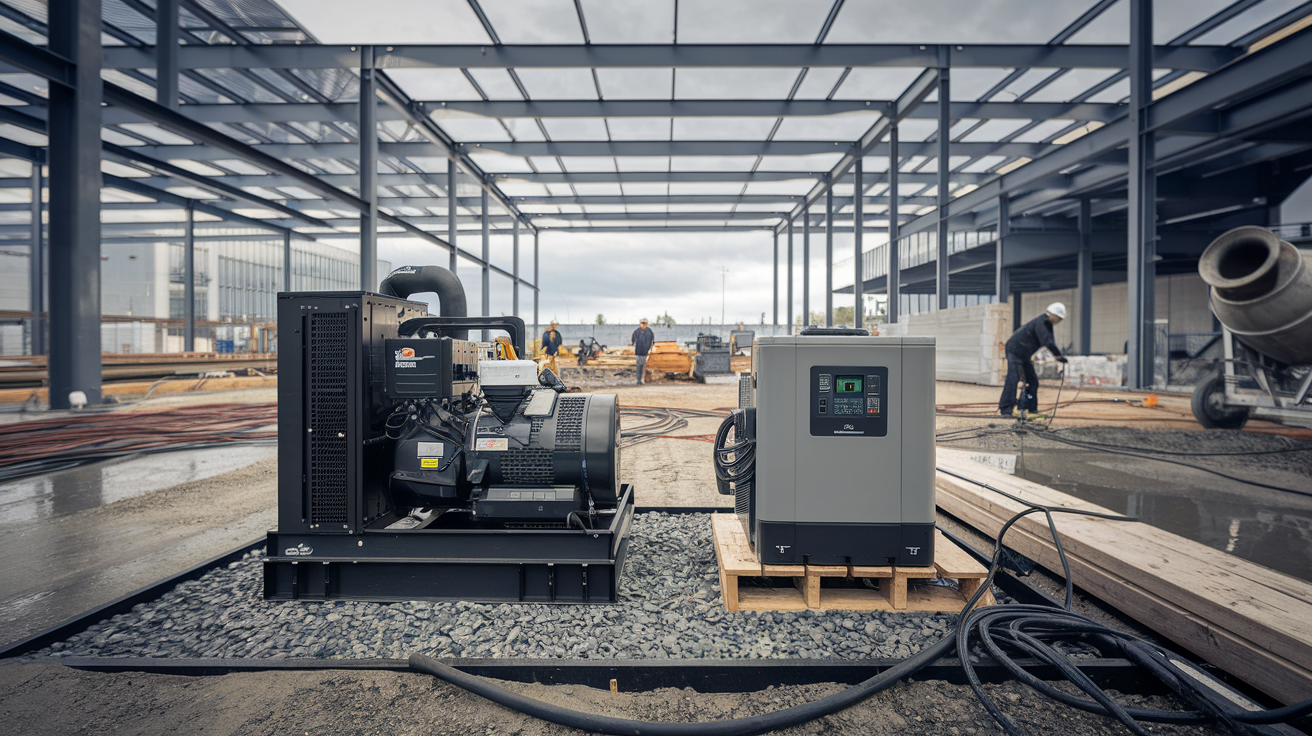
Jobsite Generator vs Portable Power Station: A Data-Driven Comparison for Commercial Sites
A direct technical comparison of ICE fuel generators vs battery-based portable power stations for commercial jobsite use — covering surge capacity, runtime math, compliance risk, total cost of ownership, and clear scenario-by-scenario verdicts for contractors and procurement managers.
Realistic Wh delivery from rated battery capacity (after efficiency losses)
Common startup surge planning range for inductive motor loads
Typical loud open-frame generator output — often difficult to use near urban jobsite limits
Contents
- Power Delivery: Continuous Draw vs Inductive Surge
- Runtime Math: How to Calculate Real-World Capacity
- IP Ratings, Certifications, and Compliance Risk
- Total Cost of Ownership: CapEx vs OpEx
- Noise, Emissions, and Site Restrictions
- Scenario Verdicts: Which Wins on Your Jobsite
- Frequently Asked Questions
The jobsite generator vs portable power station decision used to be simple — generators ran everything, batteries were for flashlights. That’s no longer true. Battery-based portable power stations now deliver 2,000W–5,000W continuous output with surge handling, runtime measured in hours not minutes, and compliance credentials that matter on commercial sites. But fuel generators still hold real advantages for specific scenarios. This comparison cuts through the marketing and gives you the technical framework to make the right call — based on load types, runtime requirements, compliance constraints, and total cost over the life of the equipment.
Power Delivery: Continuous Draw vs Inductive Surge
The most critical technical difference between a fuel generator and a battery power station isn’t total wattage — it’s how each platform handles inductive loads. Understanding this distinction determines whether your power source survives the first five minutes on a working jobsite.
Inductive loads — motors in table saws, air compressors, concrete mixers, and angle grinders — commonly draw 3x to 6x their rated continuous wattage at startup. A 15A, 120V table saw with a 1,800W continuous draw may pull 5,400W–7,200W for the 200–400 milliseconds it takes the motor to reach operating speed. This is called the surge or locked-rotor current.
Fuel generators handle surge mechanically. The engine governor responds to sudden load demand by increasing fuel delivery and RPM. This response isn’t instantaneous — there’s a brief voltage sag — but the combustion engine can often sustain elevated output for several seconds. A generator rated 5,000W continuous may have starting-watt capacity only modestly above its running output, while some designs tolerate more short-duration boost. Always size from the manufacturer’s starting watts or surge watts rating, not the running-watts number alone.
Battery power stations handle surge electronically. The inverter monitors output in real time and uses the battery’s instantaneous discharge rate (expressed as C-rate) to supply surge current. A quality LiFePO4-based station rated 3,000W continuous may deliver 6,000W surge for 5–10 seconds before the inverter’s protection circuit intervenes. If the surge demand exceeds this electronic limit, the inverter shuts down — dropping your tool mid-startup and potentially damaging the motor’s windings over repeated trips.
The practical rule: a battery power station’s rated surge capacity must meet or exceed the tool’s estimated startup surge. Use the manufacturer’s starting-watt requirement when available. If it is not available, estimate surge at 3x–6x the tool’s continuous draw for inductive motor loads. A surge rating only 2x above continuous draw may be enough for some lighter tools, but it is not a reliable pass/fail threshold for compressors, saws, mixers, or other hard-starting jobsite equipment. This is the threshold that determines the Scenario C verdict below — it is not a judgment call, it is math.
One additional distinction: fuel generators output modified or pure sine wave power depending on inverter design. For sensitive electronics and variable-speed motor tools, pure sine wave output matters. See our breakdown of pure sine wave vs modified sine wave inverters for power tools for the full technical comparison. Battery stations universally output pure sine wave from their inverters — this is a consistent advantage over open-frame generators that are not inverter-type.
Runtime Math: How to Calculate Real-World Capacity
Published watt-hour (Wh) ratings on battery stations are theoretical maximums measured under ideal lab conditions. On a real jobsite, with real loads, conversion losses, temperature variation, and partial-discharge cycling, you will not get 100% of the rated capacity delivered as usable AC power.
Use this formula for every battery station runtime estimate:
Realistic Wh Delivery = Rated Capacity (Wh) × 0.85
The 0.85 efficiency factor accounts for DC-to-AC inverter losses (typically 5–8%), battery management system overhead, and thermal derating. Apply this before dividing by your load wattage.
Runtime (hours) = Realistic Wh Delivery ÷ Continuous Load (W)
Example: A 3,000Wh battery station powering a 900W continuous load.
- Realistic Wh Delivery: 3,000 × 0.85 = 2,550Wh
- Runtime: 2,550 ÷ 900 = 2.83 hours
For a full 8-hour shift at 900W continuous draw, you would need: 900W × 8h = 7,200Wh required. Applying the efficiency factor in reverse: 7,200 ÷ 0.85 = 8,470Wh rated capacity needed. Most portable stations top out at 2,000–4,000Wh. If your runtime math pushes beyond 6,000Wh of required delivery, a single portable station will not cover a full shift. You’ll need multiple units, a scheduled recharge window (solar or grid), or a fuel generator for that scenario.
Fuel generators have a different runtime constraint: fuel tank capacity and consumption rate. A 5,000W generator running at 50% load will typically consume 0.5–0.7 gallons per hour. An 8-gallon tank gives you roughly 11–16 hours of runtime at that load — significantly longer than any portable battery station at equivalent output. However, fuel logistics, transport compliance, and storage regulations on commercial sites add cost and complexity that don’t show up in the hardware spec sheet.
For more on runtime planning in practical jobsite scenarios, see our guide to power station runtime on job sites. To run the numbers against your own tool list, use the battery sizing estimator or the jobsite power calculator.
IP Ratings, Certifications, and Compliance Risk
On a commercial jobsite, the wrong IP rating isn’t an inconvenience — it’s a liability exposure. Understanding what the rating actually means is non-negotiable before you deploy any power equipment in exposed conditions.
IP ratings are defined by IEC 60529. The rating has two digits: the first digit describes protection against solid particles (dust); the second describes protection against liquid ingress (water). The digits are not interchangeable and neither is a guarantee of overall ruggedness.
IP65: Dust-tight (first digit 6 = no ingress of dust) + protected against low-pressure water jets from any direction under rated test conditions. This does not mean submersible. It does not mean pressure-washer safe, waterproof, or suitable for sustained immersion.
IP66: Dust-tight + protected against powerful water jets under rated test conditions. A higher bar than IP65, appropriate for sites with heavier rain or hose-spray exposure, but not a blanket approval for direct pressure washing unless the manufacturer specifically allows it.
If a product’s IP rating is not confirmed by the manufacturer’s documentation, do not assume outdoor suitability. Verify before deployment in exposed conditions.
For commercial sites, IP rating is only one layer of the compliance picture. Procurement managers and site managers should also verify:
- UL 2743: The UL standard for portable power packs. Covers battery enclosure integrity, thermal runaway containment, and electrical safety. Relevant for any battery station deployed on a commercial or industrial site. Using non-UL-listed equipment on a commercial site can create warranty, safety, and insurance review problems if the equipment fails or contributes to an incident.
- OSHA requirements: OSHA construction safety rules require employers to maintain electrical equipment in safe condition and protect workers from jobsite hazards, including damaged equipment and carbon monoxide exposure. Non-listed, improperly rated, or poorly deployed equipment that contributes to a worksite incident can create OSHA, safety, and liability exposure.
- CE marking: Required for equipment sold in EU markets. Not equivalent to UL but confirms conformity with applicable EU directives.
- Indoor/enclosed space use: ICE generators produce carbon monoxide at rates that can become lethal in enclosed or semi-enclosed spaces. Fuel-burning generators should not be operated indoors or in areas without adequate ventilation. Battery power stations produce zero emissions at point of use — this is a compliance advantage, not just a preference.
Using under-rated or uncertified equipment on a commercial jobsite can create warranty, safety, compliance, and insurance review problems if the equipment fails or contributes to an incident. For procurement managers: document the IP rating, UL listing status, and intended use case for every power asset deployed on a commercial project.
Total Cost of Ownership: CapEx vs OpEx
The purchase price of a fuel generator is almost always lower than a comparable-output battery power station. A 5,000W open-frame generator may cost $800–$1,500. A battery station delivering equivalent continuous output will typically cost $2,500–$5,000+. That gap narrows — and can reverse — when you account for total cost of ownership over 3–5 years of commercial use.
| Cost Factor | ICE Fuel Generator | Battery Power Station |
|---|---|---|
| Purchase Price (5,000W class) | $800–$1,500 | $2,500–$5,000+ |
| Fuel Cost (operational) | 0.5–0.7 gal/hr at 50% load (~$1.75–$3.15/hr at $3.50–$4.50/gal) | $0 (solar) or ~$0.10–$0.20/hr (grid recharge) |
| Scheduled Maintenance | Oil changes every 50–100 hrs, spark plugs, air/fuel filters annually | None (no moving parts in battery/inverter system) |
| Unscheduled Downtime Risk | Carburetor clogs, fuel contamination, governor failure | BMS fault, cell degradation after 2,000–3,500 cycles |
| Fuel Transport & Storage | Regulatory compliance, spill risk, storage container requirements | None |
| End-of-Life Battery Replacement | N/A | Varies by manufacturer; plan for cycle replacement at year 5–8 |
At 1,000 hours of annual operation, a fuel generator running at 50% load will consume roughly 500–700 gallons of fuel per year — at $3.50–$4.50/gallon, that’s $1,750–$3,150 in fuel alone, before oil changes, filters, and downtime labor. A battery station recharged from a site grid connection or solar panels has much lower variable operating cost. The CapEx premium on the battery unit can recover within 18–36 months in high-use commercial scenarios, depending on fuel prices, electricity rates, maintenance frequency, battery life, and duty cycle.
For procurement managers building a multi-year equipment plan: model the TCO, not the sticker price. The fuel generator wins on day one. The battery station can win by year three when utilization is high enough and the site can support reliable recharge planning.
Noise, Emissions, and Site Restrictions
Noise and emissions are increasingly a hard constraint on commercial projects, not a soft preference. Urban infill construction, hospital-adjacent sites, LEED-certified builds, and night-shift work all operate under documented noise ordinances and emissions rules that can halt work or trigger penalties.
Noise: Open-frame fuel generators typically operate at 72–88 dB at 7 meters. OSHA’s permissible exposure limit for occupational noise is 90 dBA as an 8-hour time-weighted average, while 85 dBA is commonly used as a hearing-conservation/action-level threshold and aligns with more conservative exposure guidance. Many urban municipalities set jobsite noise ordinances at 65–75 dB at the property line during daytime hours and 55–65 dB at night. An 85 dB open-frame generator running after 7 PM on an urban site may violate local rules depending on the ordinance, property-line measurement, distance, and shielding.
Inverter-type fuel generators run quieter — typically 50–60 dB at partial load — but still produce exhaust and require fuel management. Battery power stations operate at effectively zero acoustic output. Fan noise during heavy discharge is typically 40–50 dB — below conversation level.
Emissions: ICE generators emit carbon monoxide, nitrogen oxides, and particulates at the point of use. This creates three distinct constraints: (1) indoor and enclosed-space CO exposure risk; (2) emissions-restricted zones on LEED projects or near sensitive sites; (3) jurisdictions with clean air regulations limiting generator use during high-alert air quality days. Battery stations produce zero point-of-use emissions. Recharging emissions depend on the grid source — a relevant but separate calculation for carbon accounting.
Fuel logistics: Transporting gasoline and diesel on commercial vehicles requires compliance with DOT hazmat regulations above certain quantities. On-site fuel storage requires appropriate containment. Spills create environmental liability. These are real operational costs and risks that rarely appear in generator purchase comparisons.
Scenario Verdicts: Which Wins on Your Jobsite
The jobsite generator vs portable power station decision resolves cleanly when you map it against specific operating scenarios. Here are the four scenarios that define the majority of commercial use cases, with unambiguous verdicts.
Scenario A: Continuous Multi-Day Remote Draw, No Grid Access
Winner: Fuel Generator. When you need sustained high-wattage output for multiple consecutive days with no grid access and no solar supplementation, the fuel generator’s duty cycle is unmatched. A battery station cannot be recharged fast enough to maintain continuous operation without grid or adequate solar input. Fuel replenishment is the only practical solution for week-long remote site power at full load. The fuel logistics cost is the price of admission.
Scenario B: Enclosed Sites, Indoor Work, Night-Shift, Emission-Restricted Zones
Winner: Battery Power Station or approved non-combustion temporary power. This is a hard compliance call, not a preference. Fuel-burning generators should not be operated indoors or in semi-enclosed spaces because of carbon monoxide exposure risk. Night-shift work on urban sites with strict noise ordinances can also make fuel generators impractical or non-compliant at many output levels. LEED-certified and emission-restricted sites may restrict or exclude combustion equipment. Battery stations, grid-fed temporary power, or approved hardwired temporary panels are the compliant path in these scenarios.
Scenario C: Short-Duration High-Draw Tasks (Concrete Mixing, Compressor Bursts, Table Saw Starts)
Winner: Determined by surge math. This is not ambiguous — it is a calculation.
Step 1: Identify the tool’s continuous wattage draw.
Step 2: Use the manufacturer’s starting-watt requirement if available. If it is not available, multiply continuous draw by 3x to 6x to estimate startup surge for inductive motor loads.
Step 3: Compare that surge figure against the battery station’s rated surge capacity.
If the battery station’s surge rating meets or exceeds the estimated startup surge: Battery station wins — it can handle the motor startup, and its zero-fuel, zero-emission, low-noise advantages apply. For example: a 1,800W continuous table saw may have a startup surge of approximately 5,400W–7,200W. A battery station with a 6,000W surge rating may handle the lower end of that range but is marginal against the upper estimate. A unit rated closer to or above the full estimated surge range gives safer headroom. Verify the actual surge rating in the product spec sheet — do not assume.
If the battery station’s surge rating does not meet the estimated startup surge: Fuel generator wins — the inverter may trip under load, creating tool damage risk and operational downtime. Use a generator with adequate manufacturer-rated starting watts instead.
Scenario D: Silent Operation Mandate or LEED / Green-Certified Sites
Winner: Battery Power Station or approved non-combustion temporary power. When the project specification, owner requirement, or local ordinance mandates zero-emission or low-noise operation, a battery power station is often the simplest qualifying solution. Fuel generators — including inverter-type — cannot meet zero-emission requirements at the point of use. This verdict applies regardless of output requirements. If the battery station’s capacity is insufficient for the load, the answer is multiple units, a scheduled recharge plan, or approved grid-fed temporary power — not a fuel generator.
Key Takeaways
- Battery power stations handle inductive surge electronically — the surge rating must meet or exceed the tool’s estimated startup surge or the inverter may trip on motor startup.
- Always apply the 0.85 efficiency factor to rated battery capacity before calculating runtime. Published Wh figures are theoretical maximums.
- If your runtime math exceeds 6,000Wh of required delivery, a single portable station will not cover a full shift — plan for multiple units, solar supplementation, or a grid recharge window.
- Fuel-burning generators should not be used in enclosed or semi-enclosed spaces because of carbon monoxide exposure risk. Battery stations, grid-fed temporary power, and approved hardwired temporary panels are safer non-combustion options for interior work.
- Verify IP rating, UL 2743 listing status, and intended use documentation before deploying any power unit on a commercial site. Non-certified equipment creates liability exposure on commercial projects.
- The fuel generator wins on purchase price. The battery station can win on 3–5 year total cost of ownership at active commercial use rates.
- Scenario C is a math problem, not a judgment call: estimated startup surge vs rated surge capacity. Run the numbers before you commit to either platform.
Frequently Asked Questions
Can a portable power station run a 240V tool on a commercial jobsite?
Most portable power stations output 120V AC only. Some high-capacity units include a 240V outlet, but this varies by model and must be confirmed in the spec sheet before purchase. For sustained 240V tool operation — large table saws, compressors, welders — a fuel generator or hardwired temporary power panel is typically the more practical solution. Always verify the output voltage configuration against your tool’s requirements before deployment.
What does UL 2743 mean for battery power stations on commercial sites?
UL 2743 is the UL standard covering portable power packs — it addresses battery enclosure integrity, thermal runaway containment, electrical safety, and performance under stress conditions. For commercial jobsite procurement, a UL 2743 listing is a baseline safety credential that confirms the unit has been independently tested against these criteria. Non-listed units may perform adequately but lack the third-party verification that protects you in an insurance or liability review if the unit fails during operation.
How do I calculate whether a battery station can start my air compressor?
Find the compressor’s continuous running wattage — typically listed on the motor plate as amperage × voltage. Use the manufacturer’s starting-watt requirement if available. If it is not available, multiply the running wattage by 3x to 6x to estimate startup surge for an inductive motor load. Then check the battery station’s rated surge capacity in its spec sheet. If the station’s surge rating meets or exceeds the estimated startup surge, it should handle the startup. If it doesn’t, the inverter may trip when the motor attempts to start. When in doubt, round up to the next surge capacity tier rather than assume marginal headroom will be sufficient in field conditions.
Are fuel generators allowed inside buildings under construction?
Fuel-burning generators should not be operated in enclosed or semi-enclosed spaces because carbon monoxide can accumulate quickly. CO is odorless and can reach dangerous concentrations in partially enclosed structures. Battery power stations produce zero emissions at the point of use, and grid-fed temporary power or approved hardwired temporary panels may also be suitable non-combustion alternatives. If you are working inside a building under construction with limited ventilation, avoid combustion equipment and use an approved non-combustion power source.
What IP rating should I look for in a power station used on an outdoor construction site?
For active outdoor construction sites with dust, concrete particulate, and exposure to rain or hose spray, IP65 is the minimum meaningful threshold — dust-tight with protection against low-pressure water jets under rated test conditions. IP66 adds protection against powerful water jets and is preferable for sites with heavier rain or washdown exposure. Neither rating implies submersion resistance, waterproofing, or automatic pressure-washer approval. Verify the manufacturer’s IP rating documentation before deployment, and do not rely on marketing language like “weatherproof” or “rugged” without a confirmed IEC 60529 rating to back it. For more detail on what these ratings mean in practice, see our guide to IP ratings for industrial outdoor power equipment.
Need help sizing a power solution for a specific jobsite scenario — remote site, enclosed build, or high-draw tool lineup? Start with the jobsite power calculator or the battery sizing estimator, then use our jobsite power guides to spec the right platform before you buy.