Best 3000W Solar Generator for Heavy-Duty Tool Charging
This guide cuts through the noise to help contractors, mobile crews, and off-grid workers pick the right 3000W solar generator for daily heavy-duty tool charging — built around surge capacity, battery chemistry, solar input, and real jobsite durability.
Surge capacity on every top pick
LiFePO4 cycle life (EcoFlow picks)
0–80% AC recharge (DELTA 3 Max Plus)
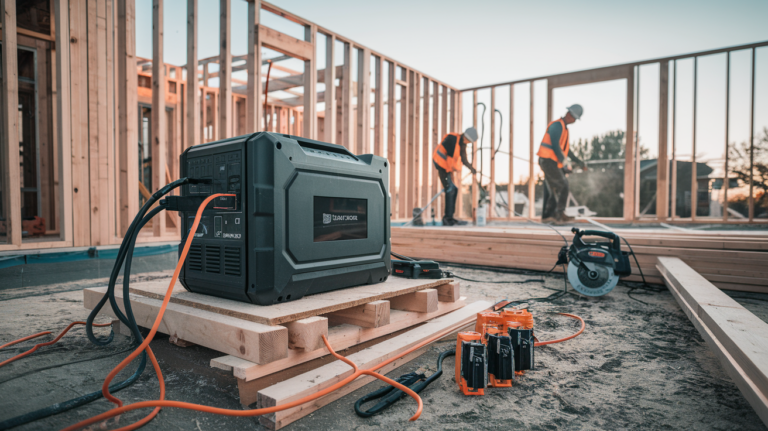
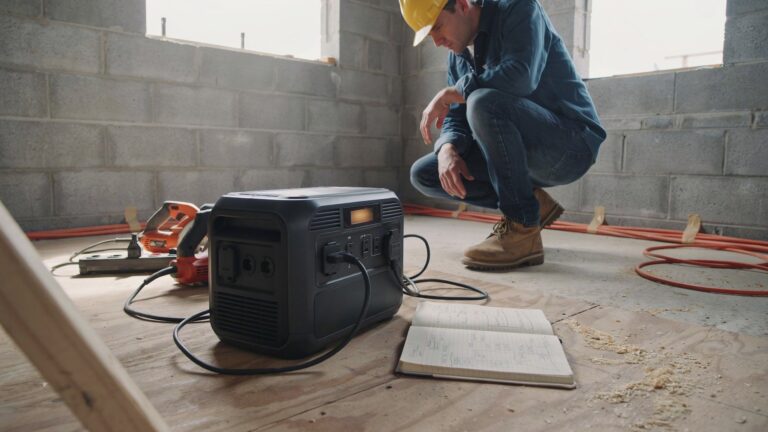
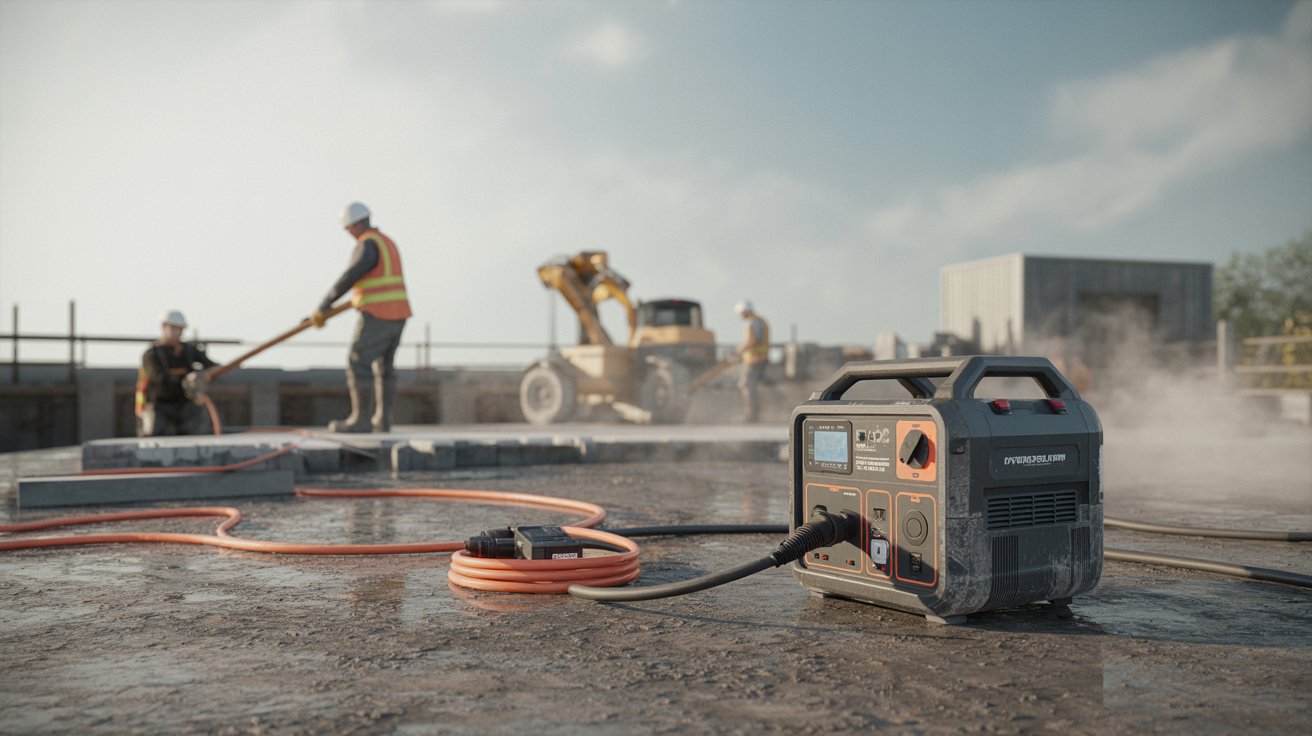
If you’re running a miter saw, charging six Milwaukee or DeWalt battery packs, and keeping a compressor ready on the same circuit, a standard consumer power station will fold on you by lunch. The best 3000W solar generator for heavy-duty tool charging is not the one with the biggest screen or the prettiest case — it’s the one that can absorb a 6000W startup spike, recover fast, and keep doing it through years of jobsite charging. This guide is built around that standard. Four power stations made the cut. Here’s exactly what they can handle and which one your operation actually needs.
What Makes a Solar Generator Work for Heavy-Duty Tools?
Most solar generators are marketed toward campers and emergency home backup. The specs that matter for those use cases — total watt-hours, number of outlets, USB ports — are the wrong specs for a working jobsite. When you’re running power tools, the questions that actually matter are different.
First, you need a pure sine wave inverter rated for your continuous tool load. A circular saw draws roughly 1200–1800W running. A miter saw pulls similar or more. An air compressor can run 1500W or higher under load. Stack two battery chargers for a 10-pack system and you’re adding another 200–400W. These loads are real and they stack fast.
Second, battery chemistry determines how the unit holds up over daily use. Lithium Iron Phosphate (LiFePO4) batteries commonly deliver around 4,000 cycles, but the retained-capacity target varies by model: the EcoFlow picks are rated to 80% capacity, while the Jackery Explorer 2000 Plus is rated to 70% capacity after 4,000 cycles. Standard lithium-ion cells in some competing units top out around 2,000 cycles to 70%. For a crew that charges on-site five days a week, LiFePO4 isn’t a luxury — it’s the difference between replacing a unit sooner versus getting years of reliable service.
Third, recharge speed is critical if you run the unit hard during the day. A solar generator that takes six or eight hours to recover from AC power is a liability. The best units in this class recover 0–80% in about an hour from a wall outlet, with some charging methods or markets varying slightly, and they can stack solar input on top of that during daylight hours.
Why Surge Capacity Matters More Than Rated Wattage
Many motor-driven tools — especially compressors, saws, and grinders — can draw two to three times their running wattage during startup. A saw that runs at 1500W may spike to 3000–4500W for a fraction of a second when the blade engages. An air compressor motor that runs at 1800W can spike to 5000W or higher on startup.
If your power station’s inverter can’t absorb that spike, it will throw an overload fault and cut power. On a jobsite, that means a tool that shuts down mid-cut, a compressor that won’t start when you need it, and a crew that’s standing around waiting for the unit to reset.
Every unit in this guide delivers 6000W surge or higher, which covers the startup demands of most single-tool loads in the 3000W class. The EcoFlow units add an X-Boost feature that extends effective output further. Do not buy a 3000W solar generator with a surge rating below 6000W for power tool use — the spec that looks like a detail on paper will cause real problems under load.
The 4 Best 3000W Solar Generators for Heavy-Duty Tool Charging
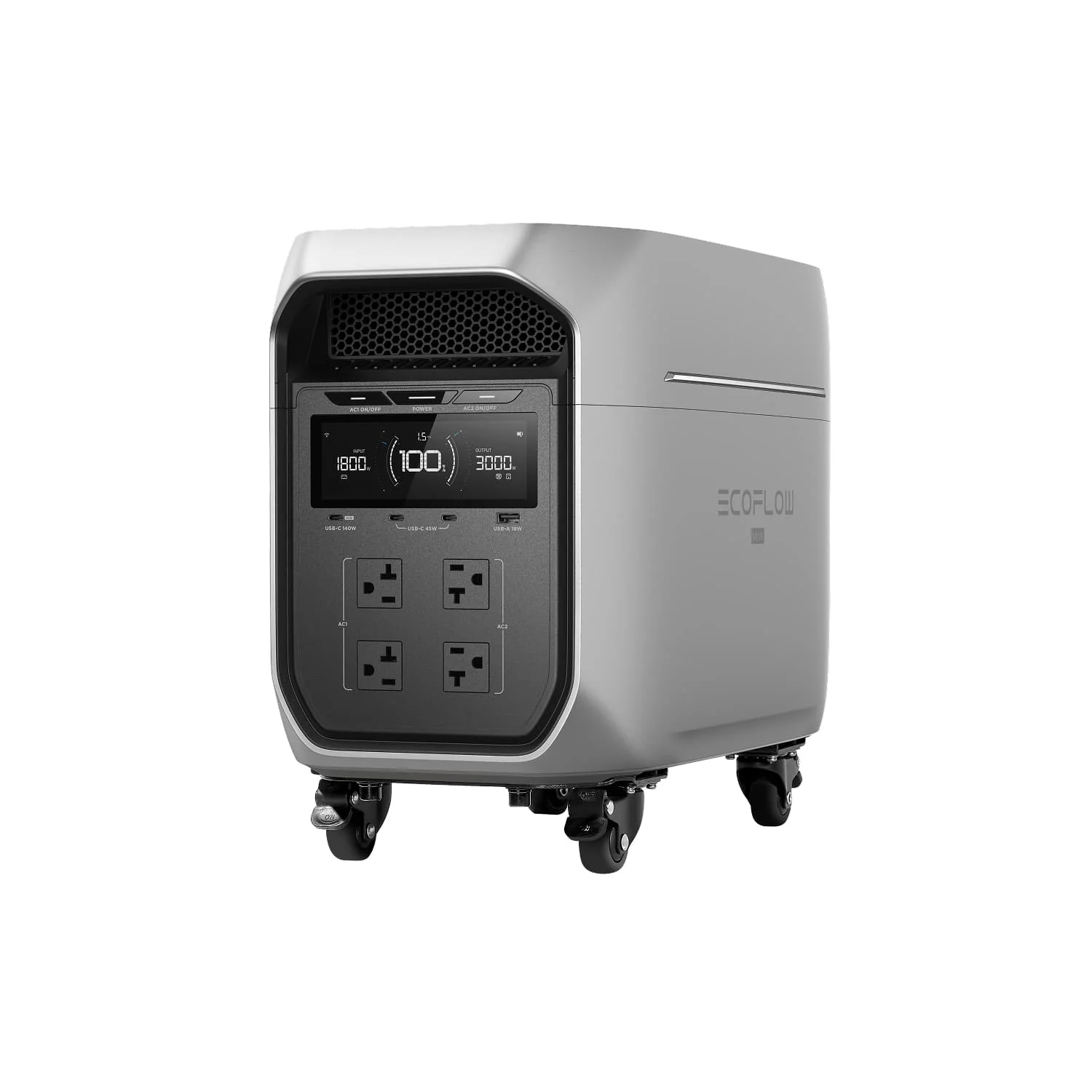
EcoFlow DELTA 3 Max Plus
2048Wh LiFePO4
X-Boost to 3800W
0–80% AC in About 1 Hour
1000W Solar Input
Expandable to 10kWh
The EcoFlow DELTA 3 Max Plus is the best overall 3000W solar generator for heavy-duty tool charging because it combines the right specs in the right package for daily jobsite use. Its 6000W surge capacity handles motor startups without faulting, X-Boost extends effective output to 3800W for demanding loads, and the LiFePO4 battery is rated for 4,000+ cycles to 80% — meaning this unit is built for daily charging cycles. About 1-hour AC recharge means you’re not waiting half a shift to top off, and expandability to 10kWh gives you room to grow without replacing the base unit.
For most contractors buying in the 3000W class, the DELTA 3 Max Plus is the answer. It weighs 49 lb, which is manageable for van loading and site-to-site moves without requiring a two-person lift. The sub-25dB noise floor at 600W output matters if you’re working in environments where a gas generator would create noise complaints. It also runs with a UPS switchover under 10 milliseconds, which protects any sensitive charging equipment or electronics tied to the unit.
The 1000W solar input allows you to pair a 4-panel array and meaningfully offset your AC recharge needs during daylight. Two panels won’t cut it for serious daily recharge — more on that in the solar section below.
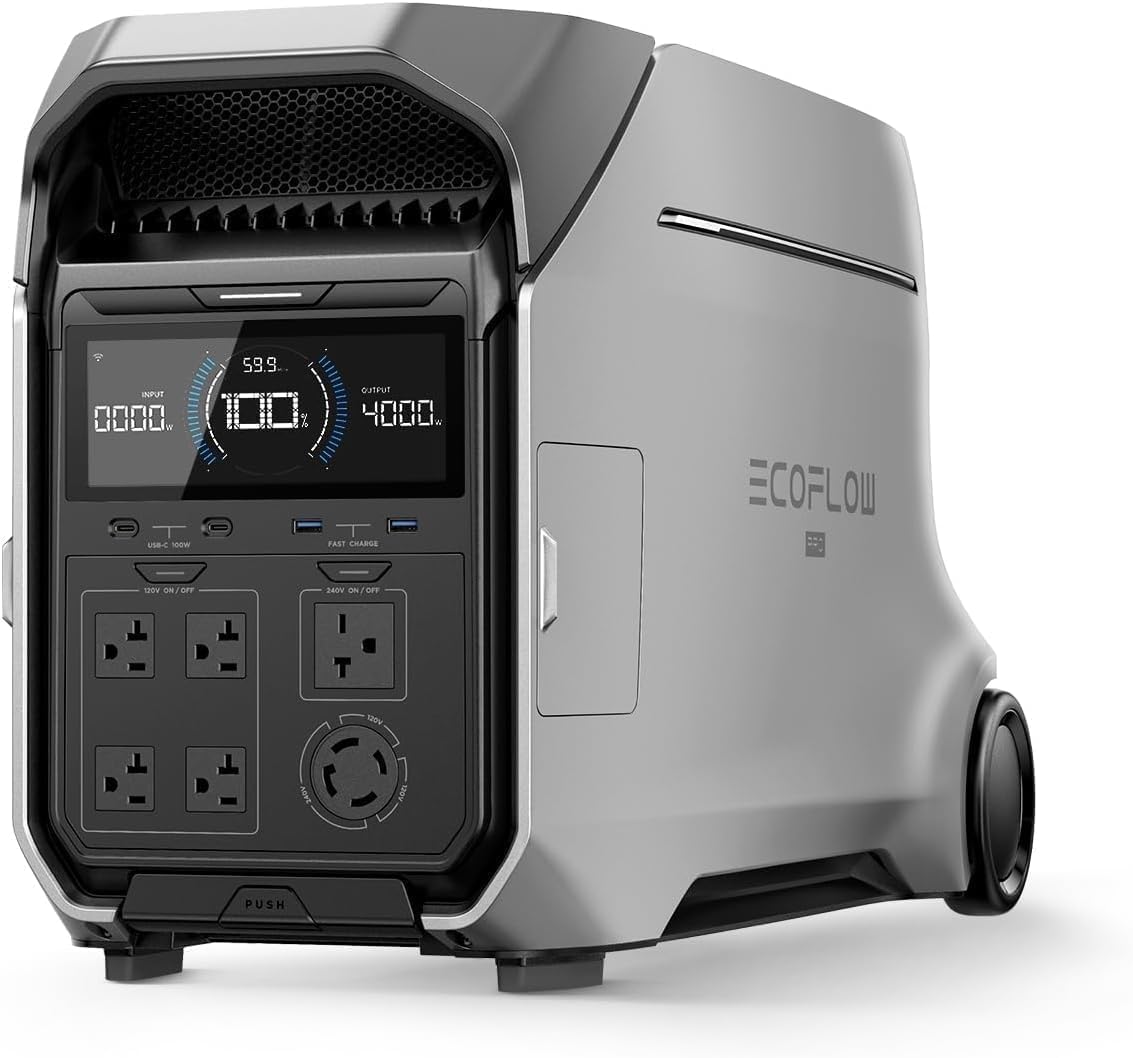
EcoFlow DELTA Pro 3
4096Wh LiFePO4
120V/240V Split-Phase
2600W Solar Input
Battery Pack IP65-Rated
Expandable to 12kWh+
The EcoFlow DELTA Pro 3 is not a 3000W unit — it’s the step-up for crews that may outgrow the 3000W category entirely. At 4000W continuous and 8000W surge, it can handle simultaneous multi-tool loads that would push the DELTA 3 Max Plus to its limit. The 120V/240V split-phase output in a single unit is a genuine commercial advantage, allowing connection to compatible 240V tools, larger compressors, and approved transfer or hardwired setups without an inverter add-on. Any connection to building circuits, transfer equipment, or hardwired power should use the proper approved connection method and be handled by a qualified electrician. Note that while its battery pack carries an IP65 rating, the main unit itself is rated IP20 and should be operated in a dry, sheltered location — not left exposed to rain or direct spray.
The DELTA Pro 3 comes in at 113 lb, so mobility is a different conversation — this is a unit you position, not one you carry between floors. But for a crew that’s stationary for a full workday, the tradeoff is worth it. The 2600W solar input means a properly sized array can genuinely keep pace with daily draw, and expansion to 12kWh (with extra batteries) gives you enough reserve to run an extended shift without AC access. Its 5-year warranty also stands above the field.
If your crew runs multiple platforms simultaneously — say, a compressor, two or three battery chargers, and a saw — and you want headroom instead of hard limits, the DELTA Pro 3 is the right call. Think of it as the unit you buy when you want to stop managing power and start working, as long as the 240V or hardwired side is set up with the proper approved equipment and qualified installation.
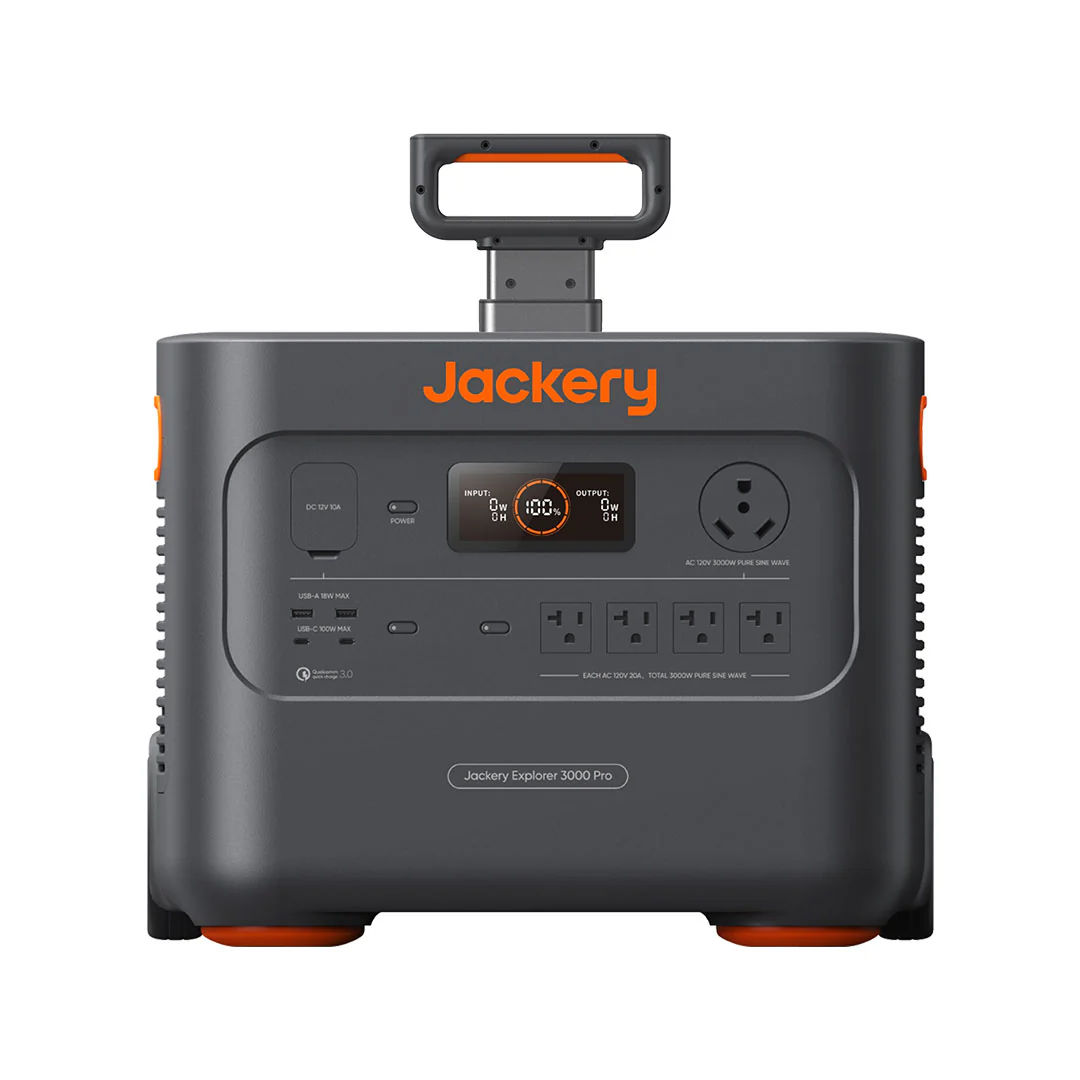
Jackery Explorer 3000 Pro
3024Wh Lithium-Ion
Up to 1400W Solar Input
Full Charge in ~2.4 Hours (AC)
Wheels + Pull Handle
The Jackery Explorer 3000 Pro is a credible 3000W jobsite unit and the most recognizable name in this category for a reason — it delivers 3000W continuous and 6000W surge in a wheeled case that loads easily into a service van. This is now an availability-dependent pick because the Explorer 3000 Pro has been shown as discontinued or no longer stocked in some markets, so confirm current availability before treating it as your primary buying target. Its 3024Wh battery is the largest raw capacity of the 3000W-class picks in this guide, which gives it strong all-day runtime when solar top-up isn’t available. The 1400W solar input ceiling is the highest in its class and the 2.4-hour AC recharge time is practical for overnight recovery.
The key limitation to acknowledge honestly: the Explorer 3000 Pro uses lithium-ion chemistry, rated for 2,000 cycles to 70% capacity. Compared to the LiFePO4 units in this guide, that’s roughly half the usable cycle life before degradation becomes noticeable. For a crew that charges daily, that matters over a 3–5 year horizon. It’s not a dealbreaker — it’s a tradeoff you’re making for portability and a larger initial battery — but it should be factored into the total cost of ownership calculation.
For mobile service vans, smaller crews, or operations where the unit moves between sites frequently, the Explorer 3000 Pro’s build quality and roll-anywhere portability is hard to argue against if it is still available at a reasonable price in your market.
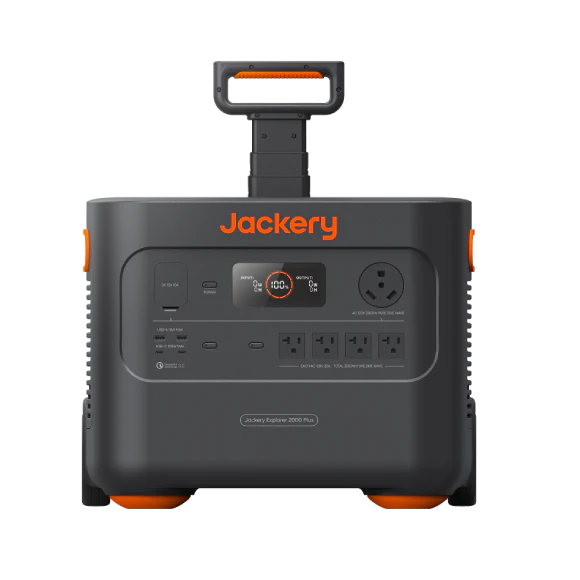
Jackery Explorer 2000 Plus
2042.8Wh LiFePO4
Expandable to 24kWh
4,000 Cycles to 70%
Up to 1400W Solar Input
~2hr AC Recharge
The Jackery Explorer 2000 Plus earns its place in this guide not as a budget fallback but as the most scalable 3000W option on the list. It starts at 2042.8Wh with 3000W output and 6000W surge — the same output numbers as the Explorer 3000 Pro — but uses LiFePO4 chemistry and supports expansion to 24kWh with add-on battery packs. For a contractor who wants to start with a manageable buy-in and add capacity as the jobsite or crew size grows, this is the most practical long-term platform in the 3000W class.
The 12-month 95% charge retention is also worth flagging for seasonal crews — if this unit sits through a slow period, it won’t be dead when you pull it back out. The 2-hour AC recharge and 1400W solar input ceiling round out a spec sheet that punches above what its base price suggests. The primary compromise compared to the Explorer 3000 Pro is the smaller base capacity (2042.8Wh vs 3024Wh), but that gap closes fast once you add a first expansion battery.
Head-to-Head Comparison
| Spec | EcoFlow DELTA 3 Max Plus | EcoFlow DELTA Pro 3 | Jackery Explorer 3000 Pro | Jackery Explorer 2000 Plus |
|---|---|---|---|---|
| Continuous Output | 3000W | 4000W | 3000W | 3000W |
| Surge Output | 6000W | 8000W | 6000W | 6000W |
| X-Boost / Boost | 3800W | 6000W | — | — |
| Battery Capacity | 2048Wh | 4096Wh | 3024Wh | 2042.8Wh |
| Battery Chemistry | LiFePO4 | LiFePO4 | Lithium-Ion | LiFePO4 |
| Cycle Life | 4,000+ to 80% | 4,000 to 80% | 2,000 to 70% | 4,000 to 70% |
| Solar Input | 1000W | 2600W | 1400W | 1400W |
| AC Recharge (0–80% / full) | About 1 hr (0–80%) | ~50–64 min (0–80%) | ~2.4 hrs (full) | ~2 hrs (full) |
| Max Expandability | 10kWh | 12kWh+ | Not modular | 24kWh |
| Weight | 49 lb | 113.5 lb | 64 lb | 61.5 lb |
| IP Rating | — | Battery: IP65 / Unit: IP20 | — | — |
| 120V/240V Split-Phase | No | Yes | No | No |
| Warranty | Verify with EcoFlow | 5 years | Verify with Jackery | Verify with Jackery |
Solar Input Reality Check for Jobsite Use
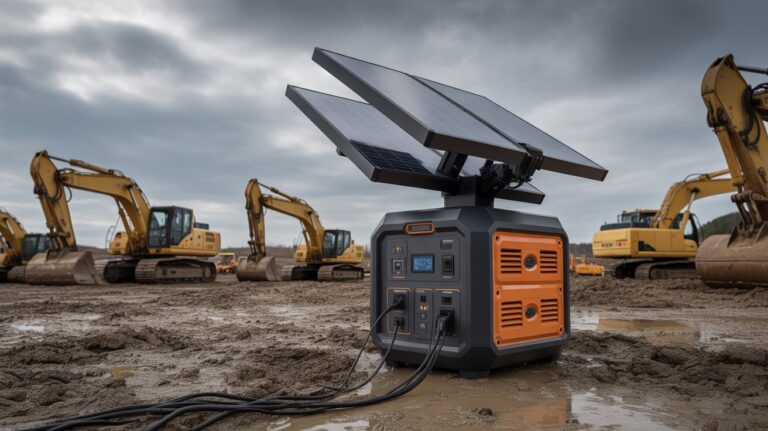
Every product in this guide supports solar charging. None of them will fully recharge from a single 200-watt panel in a workday — and you should be skeptical of any review that suggests otherwise.
Here’s the math: the EcoFlow DELTA 3 Max Plus holds 2048Wh. At full 1000W solar input, you’re looking at roughly two hours to recover 80% in ideal conditions — direct sun, optimal panel angle, clean connections, and no simultaneous draw. On a real jobsite, you’re not getting all of those. You’re getting partial shade, morning cloud cover, panels propped against a tool crib, and tools running off the same battery you’re trying to recharge.
A practical solar charging strategy for daily heavy-duty use means pairing at least 600–1000W of panel capacity with the DELTA 3 Max Plus or either Jackery unit to offset AC draw meaningfully. The DELTA Pro 3, with its 2600W solar input ceiling, is the only unit in this guide where a properly sized portable solar array can genuinely keep pace with heavy daily demand without being plugged in overnight.
If you’re genuinely running off-grid with no access to AC power between jobs, prioritize the highest solar input ceiling you can afford. That means the DELTA Pro 3 at 2600W is in a class of its own for solar-only operation. For hybrid jobsites where you have AC access at night and solar during the day, all four units are viable — but the EcoFlow units’ fast AC recharge gives them an advantage when evening recovery time is limited.
For a deeper look at sizing a solar array for off-grid work, see our guide to solar generators for off-grid power, or use the battery sizing estimator to estimate the watt-hours your setup needs.
Which Unit Is Right for Your Crew?
The decision tree here is simpler than most reviews make it. Start with your daily power draw and your recharge window, then match to chemistry and portability needs. If you’re not sure what your crew actually pulls in a day, run the numbers with the jobsite power calculator before choosing capacity.
Choose the EcoFlow DELTA 3 Max Plus if you want the best overall 3000W solar generator for heavy-duty tool charging and need the strongest balance of output, 6000W surge, fast AC recharge, LiFePO4 durability, and future expandability — all in a 49 lb package that a single person can load into a van. This is the anchor recommendation for most contractors operating in the 3000W class.
Choose the EcoFlow DELTA Pro 3 if your crew is running multiple simultaneous tool loads, needs 240V capability, or expects to grow beyond 3000W within the next year. Keep in mind the main unit requires a dry, sheltered operating environment — the IP65 rating applies to the battery pack only. At 113 lb, it doesn’t move like the others — but it doesn’t need to if it’s sitting at a base camp or stationary jobsite powering a full day’s work for multiple trades.
Choose the Jackery Explorer 3000 Pro if you want maximum base battery capacity in a 3000W wheeled unit that loads like luggage. The 3024Wh internal battery gives you the most runtime per charge of the 3000W-class options, and the brand’s service network is well-established where the product is still supported. Factor in availability, the lithium-ion chemistry, and shorter cycle life when comparing long-term value against the LiFePO4 alternatives.
Choose the Jackery Explorer 2000 Plus if your current power needs fit within 2–3kWh but you want the option to scale without buying a new unit. Its LiFePO4 chemistry, 3000W output, and expandability to 24kWh make it the most future-proof entry point in the lineup. Start smaller, add batteries when the job demands it.
For a direct side-by-side look at how these two leading platforms perform across the full product range, see our EcoFlow vs Jackery jobsite power comparison.
Key Takeaways
- The EcoFlow DELTA 3 Max Plus is the best overall 3000W solar generator for heavy-duty tool charging — 3000W continuous, 6000W surge, X-Boost to 3800W, LiFePO4 chemistry, and about 1-hour AC recharge set it apart in its class.
- Surge capacity is the spec that prevents tools from faulting out on startup — every pick in this guide delivers 6000W or higher, and the DELTA Pro 3 reaches 8000W for multi-tool commercial loads.
- LiFePO4 chemistry (EcoFlow DELTA 3 Max Plus, DELTA Pro 3, Jackery Explorer 2000 Plus) delivers around 4,000 cycles, with retained-capacity targets varying by model, versus ~2,000 cycles for the lithium-ion Jackery Explorer 3000 Pro — a meaningful difference for crews charging daily.
- A single 200W solar panel will not meaningfully recharge a 2000–3000Wh power station during a heavy workday. Plan for 600W–1000W minimum rated panel capacity, and expect real-world output to be lower under jobsite conditions.
- The EcoFlow DELTA Pro 3 is not a 3000W unit — it’s a 4000W commercial-grade step-up with 2600W solar input and 120V/240V split-phase capability for larger crews. Its battery pack is IP65-rated; the main unit requires sheltered operation, and any building-circuit or hardwired connection should use approved equipment and qualified installation.
- Portability matters differently by crew type: the DELTA 3 Max Plus at 49 lb moves easily; the DELTA Pro 3 at 113 lb is a positioned asset, not a carry unit.
- Modular expandability (DELTA 3 Max Plus to 10kWh, Explorer 2000 Plus to 24kWh) means you don’t have to buy your worst-case power scenario on day one.
Frequently Asked Questions
Can a 3000W solar generator run a miter saw?
Yes, but surge capacity is the deciding factor. A 10-inch miter saw typically draws 1500–1800W running and can spike to 3500–4500W on startup. Every power station in this guide delivers 6000W surge, which provides adequate headroom for single-saw operation. The EcoFlow DELTA 3 Max Plus adds X-Boost support up to 3800W for additional margin. Avoid running a miter saw simultaneously with other high-draw tools on the same unit unless you’re using the EcoFlow DELTA Pro 3, which offers 8000W surge and 4000W continuous for multi-tool loads.
Can a 3000W power station charge multiple power tool batteries at once?
Yes — multi-battery charging is one of the most practical use cases for a 3000W power station on a jobsite. Most professional battery chargers pull 50–150W each, so you can realistically run 6–10 chargers simultaneously well within a 3000W ceiling. The key is outlet count: the EcoFlow DELTA 3 Max Plus and EcoFlow DELTA Pro 3 both provide multiple 120V 20A AC outlets to handle parallel charger setups. Make sure you’re factoring in the surge from any charger that uses an active cooling fan or fast-charge cycle on startup.
Is LiFePO4 battery chemistry worth the premium for jobsite use?
For contractors charging daily, yes — the chemistry difference is significant over time. LiFePO4 batteries in the EcoFlow models are rated around 4,000 cycles to 80% capacity, while the Jackery Explorer 2000 Plus is rated around 4,000 cycles to 70% capacity. The lithium-ion Jackery Explorer 3000 Pro is rated for 2,000 cycles to 70%. If you’re cycling the unit every working day, LiFePO4 can meaningfully extend usable lifespan before noticeable degradation. LiFePO4 also handles thermal stress better, which matters for units sitting in service vans or on exposed jobsites in summer heat.
How much solar panel capacity do I need to keep a 3000W solar generator charged on a jobsite?
Plan for a minimum of 600W–1000W of rated solar panel capacity to meaningfully offset daily draw on a 2000–3000Wh power station during active use. Keep in mind that real-world output will often be lower than rated capacity due to shading, heat, and panel positioning. A single 200W panel will not recharge a fully depleted 2048Wh unit within a standard workday, especially with simultaneous tool loads running. The EcoFlow DELTA 3 Max Plus supports up to 1000W solar input; both Jackery units support up to 1400W; the DELTA Pro 3 accepts up to 2600W. On hybrid jobsites with AC access overnight, use solar to reduce charging time rather than relying on it as your sole recharge source. For fully off-grid sites, target 1.5–2x your unit’s daily Wh consumption to account for real-world efficiency losses.