The Best Solar Generators for Your Job Site: Cut Fuel, Kill Noise, Keep Working
Payback by Usage
LiFePO4 Cycles
Fuel Cost / Day
What Is a Solar Generator, and How Does It Differ from a Gas Generator?
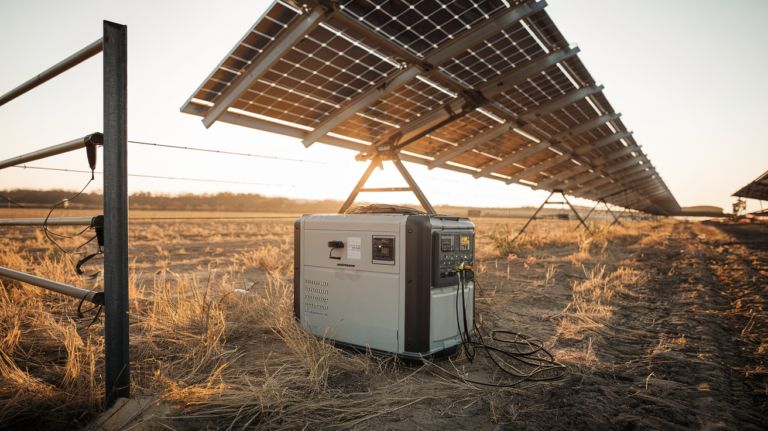
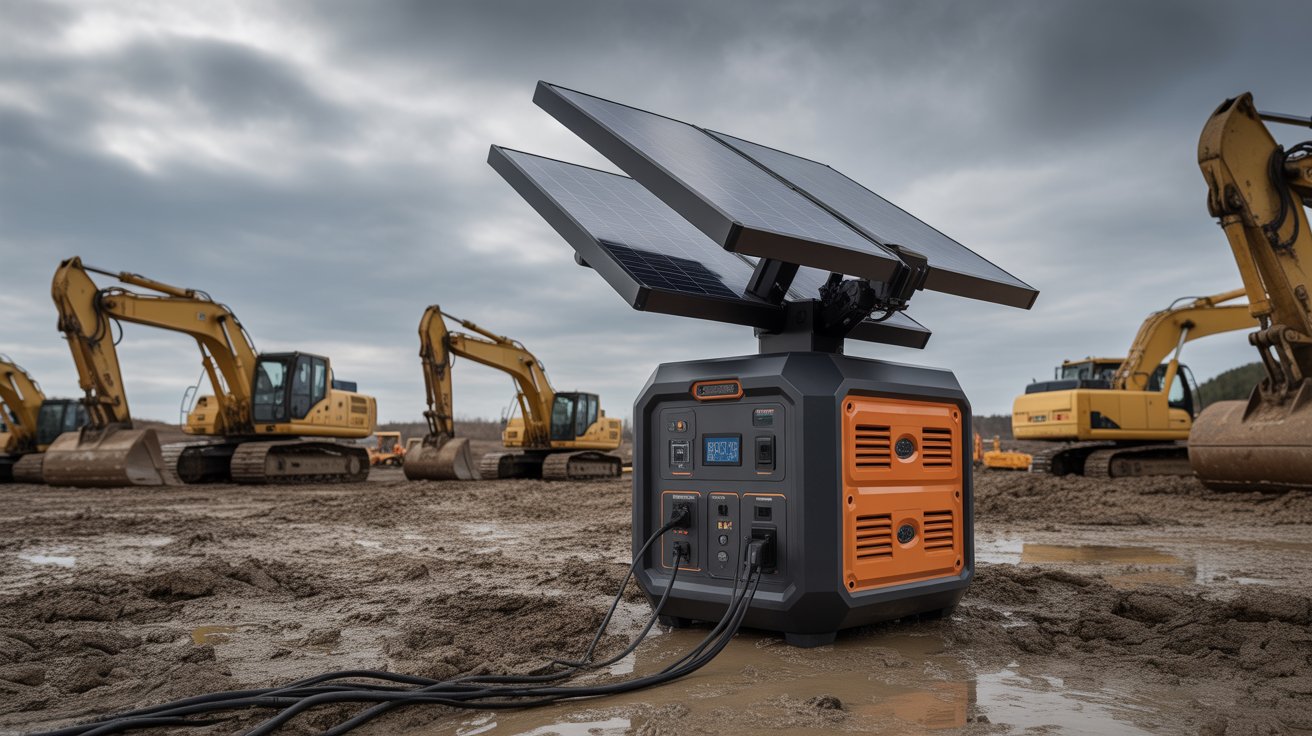
A solar generator is a self-contained unit that combines a battery pack, an inverter, a charge controller, and AC/DC outputs in one enclosure. Pair it with a solar panel array, and you’ve got a complete off-grid power system that draws energy from the sun instead of a fuel tank. Unlike a conventional generator, a solar generator produces zero emissions, zero fumes, and almost zero noise — critical factors when you’re working indoors, near occupied buildings, or in jurisdictions with strict job-site emissions rules.
The biggest misconception is that solar generators are toys for campers. Modern power generators built around LiFePO4 chemistry carry 2,000Wh to 5,000Wh of usable capacity, deliver continuous 2,000W+ output, and can handle many heavy-duty loads that used to require a gas unit. The only real trade-off is recharge time — but with smart planning, that stops being a problem fast.
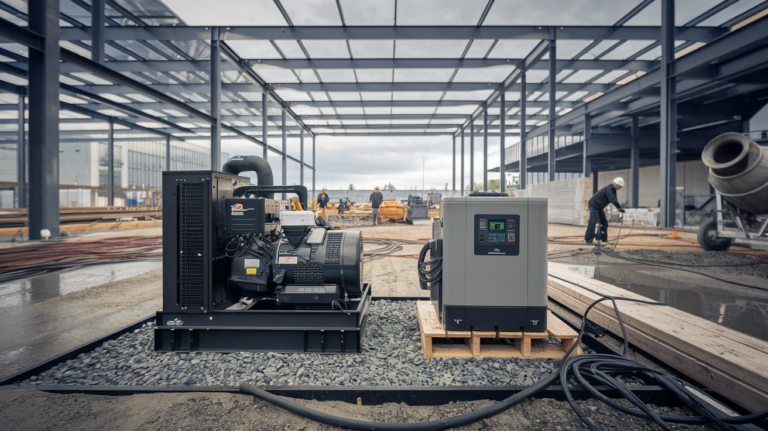
A conventional gas generator gives you instant fuel-based power anywhere, but it also costs you on fuel, noise, fumes, and maintenance. A solar generator eliminates every one of those pain points. For most job-site scenarios where power needs are predictable, the solar route is simply the smarter play.
How Much Power Do You Actually Need on a Job Site?
Before you spend a dollar, audit your power needs. If you want a fast sizing check before comparing units, use the battery sizing estimator or the jobsite power calculator to map tool wattage, runtime, and daily energy demand. Start with your highest-draw tool — a circular saw, compressor, or hammer drill — and look up its wattage on the nameplate. That number is running watts. Now multiply it by 2–3x to account for startup surge. That spike is called surge watts, and your solar generator must handle both. A unit rated at 2,000W continuous that can’t handle a 3,500W surge will trip every time you fire up a compressor.
Next, think about simultaneous loads. If you’re running power tools, a job-site radio, LED site lighting, and a phone charging station at the same time, add all those running watts together. Most crew setups land between 800W and 2,500W of simultaneous draw. That gives you a realistic target for battery capacity and output wattage before you even look at product pages.
As a rule of thumb, for light to mid-duty work (lighting, chargers, one power tool at a time), a 1,000Wh–2,000Wh unit with 1,500W output works. For full-crew sites with compressors and saws running in parallel, step up to 3,000Wh+ with a 2,000W+ continuous inverter. Don’t cheap out on the inverter spec — it’s what keeps your power output stable under load.
LiFePO4 vs. Lithium-Ion: Why Battery Chemistry Matters for Portable Power
Not all batteries are equal. Most budget portable power station units use standard lithium-ion battery chemistry — good energy density, but degrades faster under high-cycle use and runs hotter. LiFePO4 (lithium iron phosphate) is the chemistry you want for a professional workhorse. It handles 3,000–5,000 full charge cycles before significant degradation, operates safely across a wider temperature range, and is inherently more stable under sustained high-draw loads.
For a remote job site where the unit charges every day and discharges hard every day, a LiFePO4 battery will outlast an NMC lithium cell by a factor of three to five. That directly impacts your cost-per-charge economics over a three-to-five-year ownership window. Do the math — you’re not just buying a battery; you’re buying uptime reliability over hundreds of job sites.
Can a Solar Generator Power a Full Construction Crew All Day?
Yes — with the right setup. The key is pairing adequate battery capacity with enough solar panel input to keep up with daily draw. A crew using roughly 1,500Wh per day should normally look at about 400–600W of solar input as a practical starting range, assuming 4–5 peak sun hours and real-world losses from panel angle, heat, wiring, and charge conversion. A 200W array may offset part of that load, but it usually will not replace 1,500Wh reliably on a working job site. Most modern solar generators support pass-through charging, so you can draw power while panels are still recharging the pack — that can extend runtime significantly, but it only becomes continuous power when solar input keeps up with the active load. For cleaner sizing, run the load list through the jobsite power calculator before buying panels.
Shadowing is the enemy. Position your panels where they’re not blocked by equipment, scaffolding, or buildings. Even partial shade on a series-wired panel string tanks the entire string’s output. Parallel wiring or MPPT-optimized controllers handle partial shade far better. Most high-end solar powered generators include built-in MPPT charge controllers — a feature worth verifying before you buy.
Solar generators provide the most value on multi-day projects where you’re not hauling fuel cans back and forth. Set up your solar array, let the system charge using the next morning’s sun, and you walk onto site with a full pack when the system is sized correctly for the previous day’s draw. That’s not a theory — that’s how crews running these systems operate.
Real-World Use Cases: Where Solar Generators Outperform Gas on Job Sites
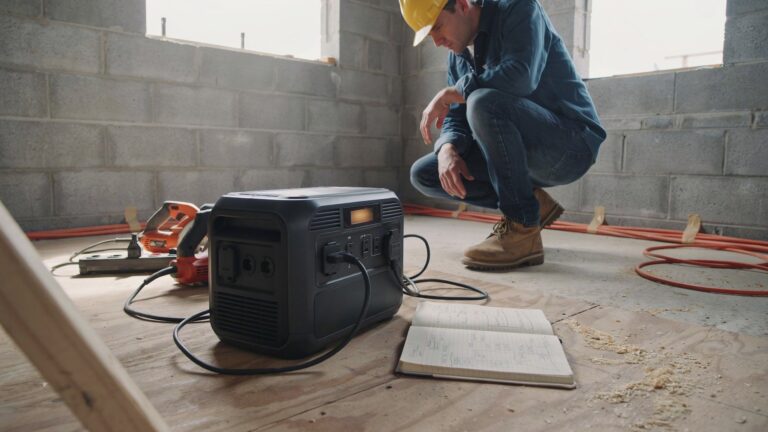
The real-world use cases that consistently favor solar fall into a few clear categories. Indoor renovation work tops the list — no fumes, no exhaust risk, no worrying about CO buildup in tight spaces. Finish carpenters, painters, drywallers, and flooring crews have been switching in droves because running a gas unit indoors was never viable and an extension cord from the panel isn’t always available.
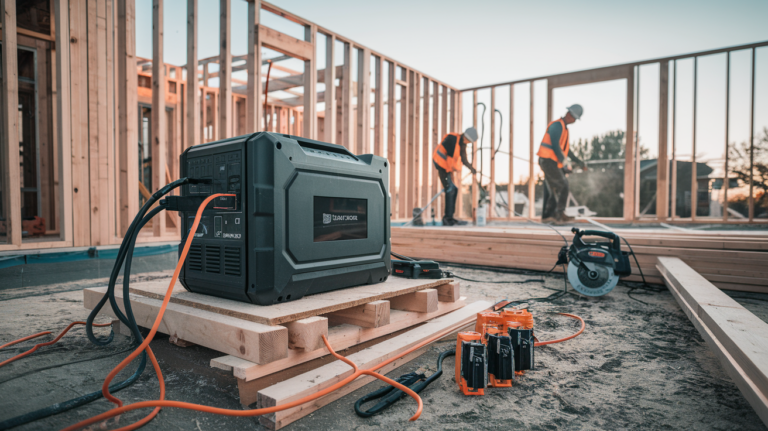
Urban and residential construction sites are another natural fit. Noise bylaws in many cities restrict generator use during early mornings and evenings. A solar generator runs essentially silent — no restriction issues, no neighbor complaints, no bylaw fines. For a contractor managing timelines in dense residential neighborhoods, that compliance advantage alone justifies the investment.
Landscaping, signage installation, road construction, and utility maintenance crews working in open areas hit the sweet spot for solar power. Open sky means maximum panel output. These crews are also often moving site-to-site within a region, and the portable solar generator form factor — wheeled, compact, no fuel logistics — fits that workflow perfectly.
Bluetti Elite 300 Portable Power Station
2,400W Continuous
LiFePO4
1,200W Solar Input
4,800W Surge
6,000+ Cycles
One of the strongest compact Bluetti solar units for professional use. Its LiFePO4 battery, 2,400W continuous inverter, and 4,800W surge rating make it a practical workhorse for construction site generator duty when the tool load is sized correctly. Supports up to 1,200W solar input for faster daytime recovery. Handles common saws, chargers, lighting, and many light-to-mid-duty crew loads without dragging a gas generator onto the site. Rated for 6,000+ cycles.
What Should You Look for When Buying a Solar Generator for a Job Site?
Start with output — specifically, the continuous watt rating of the inverter and the surge capacity. Don’t let marketing peak-watt numbers mislead you; what matters for running tools is the continuous figure. Then check wattage of your loads and make sure there’s at least 20% headroom above your expected simultaneous draw. That buffer protects the unit during unexpected spikes and extends its lifespan.
Battery chemistry, as covered above, should be LiFePO4 for any unit you plan to use professionally. Then look at input flexibility — can it charge from solar, AC wall outlet, and a vehicle alternator simultaneously? That multi-input capability gives you reliable power in all conditions, not just sunny days. A unit that can only charge from solar is a liability in overcast conditions.
Finally, check the output port array. Job sites need multiple AC outlets, USB-A and USB-C for devices, and ideally a 12V DC port for site-specific equipment. Weight and mobility matter too — a 30kg unit with no wheels isn’t portable; it’s just a heavy box. Look for a compact chassis with a solid handle or wheel system you can actually move solo.
How Do Solar Generators Perform When Grid Power Isn’t Available?
This is where the off-grid power case is ironclad. If you’re working on a remote build, a new subdivision before utility hookup, or a rural project hours from the nearest grid power connection, your only options are fuel or solar. Solar wins on operating cost every time — there’s no fuel to buy, no truck to send, no supply interruption risk. A fully loaded 3,000Wh unit with a 400W solar array can stretch runtime and recover part of the daily draw, but it is only self-sustaining when daily solar harvest is greater than daily energy use. If the crew consumes 3,000Wh and the panels only recover part of that after real-world losses, the battery will still trend down. Size the system against actual loads instead of assuming daylight equals unlimited runtime.
On sites with unreliable or intermittent utility access — partial builds, renovation jobs where the main panel is off — a large portable power station acts as effective backup power. During a power outage or utility disruption, the unit keeps your crew working rather than standing around. Some contractors have also started keeping a dedicated unit in the work truck purely as emergency backup — a strategy that pays for itself the first time a power outage shuts down a competing crew but not theirs.
Solar Generators Don’t Produce Fumes — Why That Matters More Than You Think
Solar generators don’t emit exhaust, which sounds obvious until you’ve had a jobsite inspection flag your gas unit for running indoors or a client complain about diesel smell near their occupied building. Gas generators should not be run indoors, in enclosed spaces, or in poorly ventilated areas because carbon monoxide can build up fast. In commercial renovation and interior fit-out work, the indoor air quality concern is real and regulatory. OSHA’s CO exposure limits are easy to hit in poorly ventilated spaces with a running gas generator, and the liability exposure is significant.
Eliminating fumes also matters in food-service construction, healthcare facility renovations, and any occupied-building work where clients have zero tolerance for emissions. A solar generator is the only power source that fits those environments without compromising. It’s not a compliance trick — it’s genuinely the right tool. And for crew comfort and safety on enclosed sites, removing fumes from the equation isn’t optional; it should be standard.
EcoFlow DELTA Pro 3 — 4,000W / 4.1kWh LiFePO4
4,096Wh LiFePO4
8,000W Surge
2,600W Solar Input
120V/240V Output
Expandable Capacity
The EcoFlow DELTA Pro 3 is a high-capacity portable station for crews that need more inverter headroom. Its 4,000W continuous AC output, 8,000W surge rating, and 4,096Wh LiFePO4 pack handle many common jobsite tools when loads are sized correctly. It supports up to 2,600W solar input under optimal conditions, so a properly sized solar array can recharge it quickly in strong sun. Doubles as a home or shop backup unit between jobs, making it one of the stronger options for contractors who want one asset for jobsite and backup power.
How Do Off-Grid Solar Power Systems Scale for Bigger Operations?
Single-unit portable generator solutions work for small crews. For larger operations, the best approach is modular — run two or three units as independent off-grid stations at different zones on the site rather than running one massive unit with long extension cable runs. This also gives you redundancy: if one unit needs recharging, the others keep the critical zones powered. That’s how professional power systems should be designed — distributed, not single-point-of-failure.
Some crews combine solar with a small grid-tied temporary service when available, using grid power overnight to top off batteries and solar during the day to cover draw. This hybrid approach maximizes renewable energy use while maintaining uninterrupted coverage regardless of sun hours. It’s also how you stretch a modest solar budget — you’re not trying to go 100% solar on day one; you’re intelligently displacing fuel consumption and maximizing uptime.
On large commercial sites, power generators scale via battery expansion modules. Units like modular Bluetti systems and EcoFlow DELTA Pro 3 setups support external battery packs that expand stored capacity without adding a separate generator unit. This is clean energy scaling done right — modular, silent, and built around renewable inputs rather than fuel logistics.
Energy Independence on the Job Site: Is Solar Power Worth the Investment?
The economics depend on usage. A quality solar generator setup can cost anywhere from roughly $1,500 to $3,500+ before panels, extra batteries, and accessories, so payback depends on how often it replaces a fuel generator. If a crew currently spends $30–$50/day in fuel on the days a gas generator is running, regular use can create meaningful annual savings. For occasional use, the payback is slower; for daily crews, it can be much faster. Use the battery sizing estimator to estimate daily energy use before assuming a payback number.
There’s also the equipment angle. A LiFePO4 solar generator with 3,500+ rated cycles can outlast many gas generators in calendar time when used within spec. There’s no oil to change, no carb to clean, no fuel to stabilize over winter. Maintenance cost is much lower. Over a five-year horizon, a solar generator can be the lower total-cost solution in many use cases — and the resale picture can remain stronger when the battery still has healthy cycle life.
For contractors who use solar power on the job site, there’s also a client-perception benefit that increasingly matters. Sustainable jobsite practices are a differentiator in competitive bids, especially for commercial clients with ESG reporting requirements. Showing up with solar power instead of a diesel-chugging gas unit signals professionalism and forward thinking. In tight bid environments, every edge counts.
Key Takeaways
- Match your solar generator’s continuous watt output to your highest simultaneous load — don’t ignore surge specs
- LiFePO4 battery chemistry is the professional standard: 3,000–5,000 cycles vs. 500–1,000 for standard lithium-ion
- Solar generators produce zero fumes, near-zero operating noise, and zero fuel cost — critical advantages for indoor and urban job sites
- Pair your unit with a proper solar array sized to your daily draw — MPPT charge controllers handle partial shade far better
- For large operations, run multiple units in distributed zones rather than one oversized single unit
- Bluetti Elite 300 and EcoFlow DELTA Pro 3 are strong production-grade options for contractor use
- The payback period on a quality solar generator depends on fuel displacement, usage frequency, solar kit cost, and extra battery needs
- Solar generators work as backup power, off-grid power, and emergency power — one asset, multiple use cases
Ready to cut the fuel bill and bring reliable, clean power to your next job site? Start by sizing your daily loads, then compare the units above against your actual wattage, runtime, and solar recharge needs. Don’t wait until your gas generator quits on you mid-project.